

Board Performance · 2025
In this section15 topics
- Compliance Monitoring — Overview2 items
- Prevention of Conflicts of Interest4 items
- Prevention of the Use of Inside Information4 items
- Anti-Corruption5 items
- Whistleblowing4 items
- Selection of Directors & Chief Executives8 items
- Selection of Independent Directors4 items
- Director Development4 items
- Evaluation of Board & Subcommittee Performance3 items
- Subcommittees1 item
- Meeting Attendance & Remuneration8 items
- Supervision of Subsidiaries & Associated Companies5 items
- Board Duty Performance — Overview1 item
- Audit Committee Duty Performance2 items
- Executive Committee Duty Performance1 item
Compliance Monitoring — Overview
Compliance Monitoring — Introduction
The Company places importance on good corporate governance and has established related policies and practices within its corporate governance policy of the Company and its business ethics, and mandates continuous monitoring and evaluation of compliance to ensure concrete implementation and build confidence among all stakeholder groups.
The Board of Directors believes that good corporate governance principles will bring maximum benefits to the Company, its shareholders, and all stakeholder groups. For this reason, the Corporate Governance Principles for Listed Companies 2017 (“Corporate Governance Principles of 2017”)
which can be divided into 8 (eight) principles, namely:
1. Recognizing the roles and responsibilities of the Board of Directors as organizational leaders who create sustainable value for the business.
2. Defining the primary objectives and goals of the business for sustainability.
3. Strengthening an effective Board of Directors.
4. Recruitment and development of senior executives and human resource management.
5. Promoting innovation and responsible business operations.
6. Ensuring appropriate risk management and internal control systems.
7. Maintaining financial credibility and information disclosure.
8. Supporting shareholder engagement and communication.
The Company's Corporate Governance Principles have been established in accordance with the Corporate Governance Principles of 2017 to serve as guidelines for the Board of Directors, who are the leaders and ultimately responsible for the Company. This version of the Corporate Governance Principles specifies the roles, duties, and responsibilities of
the Board of Directors in creating sustainable long-term value for the business. The value created not only benefits the Company but also its shareholders, stakeholders, the capital market, and society as a whole.
The Board of Directors mandates a review of the corporate governance policy at least once a year to achieve sustainability objectives and to serve as a guideline for performing duties within the scope of authority under good corporate governance principles, adhering to transparency, fairness, and compliance with relevant laws, regulations, and organizational ethics and code of conduct.
In the event of a review or further amendment of the policy to align with the Company's operational situation or changes in relevant laws, regulations, and criteria, the Company Secretary, in collaboration with the Compliance Officer, will conduct an initial review and present it to the Executive Committee meeting for screening and consideration within the scope of authority and responsibilities defined in the Executive Committee Charter, and then submit it to the Board of Directors for approval.
In 2025, the Company systematically monitored and evaluated the implementation of its corporate governance policy to ensure that its operations adhere to good corporate governance principles and comply with relevant laws, regulations, and practices. The results of this evaluation were used to review the policy and were presented to the Board of Directors' meeting for consideration and approval, in accordance with the established governance process.
Furthermore, the Company has continuously conducted activities to communicate, educate, and monitor compliance with its corporate governance policy, with key details as follows:
1. Providing knowledge lectures to the Board of Directors: The Company organized a lecture to present information on relevant principles and practices, aiming to make directors aware of their roles, duties, and responsibilities in adhering to the Company's business ethics and corporate governance policy. The content covered key issues such as prevention of insider trading, prevention of conflicts of interest, anti-corruption and bribery, enterprise risk management, as well as environmental management policies and practices. This action is considered an annual review in accordance with corporate governance practices expected of the Board of Directors, with 100% attendance from all directors.
2. Communication and monitoring in e-Learning activities for executives and employees: The Company has continuously provided e-Learning and assessments to enhance the knowledge, understanding, and awareness of executives and employees regarding their roles, duties, and responsibilities in adhering to the Company's business ethics and corporate governance policy. The learning content covers key issues similar to the lectures for the Board of Directors, including prevention of insider trading, prevention of conflicts of interest, anti-corruption and bribery, enterprise risk management, and environmental management policies, to promote concrete implementation throughout the organization and support effective and sustainable corporate governance.
All senior executives and employees participated in the learning and successfully completed the assessments, representing 100% of the total.
Monitoring of Compliance with Other CG Policies & Guidelines
The Company is committed to continuously enhancing and developing the effectiveness of its operations in corporate governance, social responsibility, community engagement, and environmental stewardship. This commitment is upheld by strictly adhering to its Corporate Governance and Business Ethics Policy, Anti-Corruption Policy, Sustainability Policy, and all related practices. This is to achieve sustainable business growth, build confidence among all shareholders and stakeholders, and elevate international recognition.
In 2025, the Company participated in the Jump+ project to enhance its potential and increase organizational value. This involved establishing a governance strategy covering both fundamental and additional objectives, along with a comprehensive consideration of related risk factors. Furthermore, the Company has defined guidelines to elevate operations in anti-corruption, whistleblower management, and information security governance. This is to align with the nature of its business operations, support growth according to the business plan, and build long-term confidence in the Company's products and services.
The Company organized a presentation during the Board of Directors' meeting to provide knowledge and review environmental management policies and practices. This was to enhance understanding of sustainability strategies and operational plans in alignment with the Company's objectives, and to reinforce the roles, duties, and responsibilities of directors in overseeing corporate governance in accordance with established criteria. All directors attended the presentation and policy review, representing 100 percent of the total number of directors.
The Company organized a presentation during the Board of Directors' meeting to provide knowledge and review enterprise risk management policies and practices. This was to enhance understanding of the roles, duties, and responsibilities of directors within the enterprise risk management process. All directors attended the presentation and policy review, representing 100 percent of the total number of directors.
Compliance officers have developed e-Learning materials with post-learning assessments for all senior executives to enhance their knowledge and understanding of the company's enterprise risk management policies and practices. All senior executives participated in the learning and successfully completed the assessments, representing 100 percent of the total number of senior executives.
Compliance officers have developed e-Learning materials with post-learning assessments for all employees to enhance their knowledge and understanding of the company's enterprise risk management policies and practices. All employees participated in the learning and successfully completed the assessments, representing 100 percent of the total number of employees.
To ensure comprehensive communication and dissemination of environmental management policies and practices, as well as enterprise risk management policies and practices, compliance officers have disseminated the relevant policies and practices through the TBN PM system, which is the Company's internal communication system. This allows directors, senior executives, and employees to access information conveniently and continuously.
Prevention of Conflicts of Interest
Has the Company Acted to Prevent Conflicts of Interest?
Yes
Operations in the Past Year
The Company has established a written conflict of interest prevention policy and conducts an annual review of this policy to align with good corporate governance principles and regulatory requirements. At the Board of Directors Meeting No. 5/2025, held on November 13, 2025, the meeting considered and reviewed the 2025 conflict of interest prevention policy, which is an integral part of the Company's Corporate Governance Policy and Business Ethics Code.
The Company has disclosed the aforementioned policy in Report Part 2: Corporate Governance Policy. Topic 6.1.2 Policies and Practices, and Measures related to Shareholders and Stakeholders Further details on the Corporate Governance Policy and Business Ethics Code can be found on the Company's website: https://investor.tbn.co.th/cpg/cpg_home?menu=TAKE_CARE_INFO_HOME or https://drive.google.com/file/d/1Zjql_HttR7x7wQe2II-a9oPx9D5WwKuJ/view
In 2025, the Company has established measures to monitor and supervise compliance with guidelines regarding interests and conflicts of interest as stipulated in the Business Ethics Code, with details as follows:
1. The Company Secretary is responsible for ensuring that relevant departments prepare reports on intercompany transactions and reports on transactions with related parties, which are submitted to the Audit Committee and the Board of Directors for acknowledgment on a quarterly basis.
2. The Company Secretary ensures that directors and executives review and update their personal interest information annually, with the process conducted in December to ensure the data is current and complete.
Furthermore, at the Board of Directors Meeting No. 5/2025 held on November 13, 2025, the meeting resolved to approve the revision of the policy and practices for reporting the trading of the Company's shares. This revision requires directors and executives to notify the Company of their share trading at least 1 business day in advance of the transaction, in order to enhance transparency and prevent conflicts of interest.
3. The Company Secretary organized a presentation during the Board of Directors meeting to provide knowledge and review policies and practices related to interests and the prevention of conflicts of interest. This initiative aims to enhance directors' awareness of their roles, duties, and responsibilities in ensuring compliance with established criteria. All directors attended the presentation and policy review, representing 100% of the total number of directors.
4. The Compliance Officer has developed e-Learning modules with post-learning assessments for all senior executives to enhance their knowledge and understanding of practices related to interests and the prevention of conflicts of interest. All senior executives participated in the learning and successfully passed the assessments, representing 100% of the total number of senior executives.
5. The Compliance Officer has developed e-Learning modules with post-learning assessments for all employees to enhance their knowledge and understanding of practices related to interests and the prevention of conflicts of interest. All employees participated in the learning and successfully passed the assessments, representing 100% of the total number of employees.
6. To ensure comprehensive communication and dissemination of the conflict of interest prevention policy, the Compliance Officer has disseminated relevant policies and practices through the TBN PM system, which is the Company's internal communication system, to enable directors, senior executives, and employees to access information conveniently and continuously.
7. To ensure continuous compliance with the conflict of interest prevention policy, the Company has assigned the Compliance Officer, in collaboration with the Human Resources Department, to communicate and foster understanding among senior executives and employees. The Human Resources Department is tasked with communicating relevant policies and practices via email to ensure that these individuals are aware of and strictly adhere to them.
Number of Conflict-of-Interest Cases — Introduction
In 2025, the Company found no instances of non-compliance and received no reports or complaints concerning conflicts of interest that violate the criteria set by regulatory bodies and the principles of good corporate governance.
Number of Conflict-of-Interest Cases
| Metric | Current Year | Previous Year | Two Years Ago |
|---|---|---|---|
| Total number of cases or issues related to conflicts of interest (cases) | 0 | 0 | 0 |
Prevention of the Use of Inside Information
Has the Company Acted to Prevent the Use of Inside Information?
Yes
Operations in the Past Year
The Company has established a policy on the use of the Company's inside information and a policy on the use of inside information and securities trading by directors, executives, employees, and persons with inside information of the Company. This is to prevent such persons who possess material non-public inside information from using it for their own benefit or the benefit of others, whether directly or indirectly, and regardless of whether compensation is received, as a guideline for future practice.
The Company has disclosed the said policy in Part 2 of the Corporate Governance Policy report. Topic 6.1.2 Policies, Practices, and Measures related to Shareholders and Stakeholders Further details on the Corporate Governance Policy and Business Ethics can be found on the Company's website: https://investor.tbn.co.th/cpg/cpg_home?menu=TAKE_CARE_INFO_MENU8
In 2025, the Company monitored the oversight and prevention of insider trading for personal gain as follows:
1. The Company Secretary issued an advance notice to directors, executives, employees, and related persons regarding the blackout period for securities trading. This prohibits the aforementioned designated persons from trading the Company's securities during the 30-day period prior to the disclosure of quarterly and annual financial statements, and within 24 hours after such financial statements are disclosed. This also includes other periods that the Company may designate from time to time.
For notifications regarding the prohibition of securities trading, the Company Secretary will communicate through e-mail and internal Line Group channels to inform directors, senior executives, and employees of the Company's securities trading blackout period and to emphasize strict adherence to the policy and guidelines on insider information usage and securities trading. This also includes reviewing related practices to ensure that securities trading is appropriate, transparent, and in compliance with established criteria.
There is no evidence of significant trading of the Company's securities during the aforementioned period.
2. The Company reviewed and amended policies and practices related to the use of inside information to align with good corporate governance principles. These amendments were considered and approved by the Board of Directors Meeting No. 5/2025, held on November 13, 2025, as follows:
(1) Approved the amendment and addition to the policy on the use of inside information and securities trading by directors, executives, employees, and persons with inside information of the Company.
The amendments were made to align with good corporate governance principles, by adding guidelines for directors and senior executives to notify information regarding the trading of the Company's shares at least
1 day in advance before trading.
The Company has adhered to the revised policy since its effective date, requiring directors and senior executives to notify their intention to trade securities at least 1 business day prior to the transaction, through the channels designated by the Company Secretary.
(2) Approved the review of the Company's insider trading prevention policy.
(3) Approved the review of the Company's information disclosure policy.
3. The Company Secretary has followed up with directors, executives, and related persons to prepare and submit reports on changes in securities holdings of the Company, in accordance with Section 59 of the Securities and Exchange Act, through the electronic system of the SEC, within 3 business days from the date of purchase, sale, transfer, or acceptance of transfer of the Company's securities.
Furthermore, the Company Secretary has followed up with directors and senior executives to prepare and submit their conflict of interest reports to the Company Secretary within 3 business days from the date of data change. The Company Secretary will compile this information and present a report to the Board of Directors meeting for acknowledgment whenever a meeting is held.
4. The Company organized a presentation to provide information through a Board of Directors meeting to educate and review policies and practices related to the prevention of insider trading, thereby enhancing awareness of the roles, duties, and responsibilities of directors in ensuring compliance with established criteria. All directors attended the presentation and policy review, representing 100 percent of the total number of directors.
5. The Compliance Officer developed e-Learning modules with post-learning assessments for all senior executives to enhance their knowledge and understanding of practices related to preventing insider trading. All senior executives participated in the learning and successfully completed the assessments, representing 100 percent of the total number of senior executives.
6. The Compliance Officer developed e-Learning modules with post-learning assessments for all employees to enhance their knowledge and understanding of practices related to preventing insider trading.
All employees participated in the learning and successfully completed the assessments, representing
100 percent of the total number of employees.
7. To ensure comprehensive communication and dissemination of the insider trading prevention policy, the Compliance Officer has distributed the relevant policies and practices through the TBN PM system, which is the Company's internal communication system, to enable directors, senior executives, and employees to access information conveniently and continuously.
8. To ensure continuous compliance with the insider trading prevention policy, the Company assigned the Compliance Officer, in collaboration with the Human Resources Department, to communicate and build understanding among senior executives and employees. The Human Resources Department is tasked with communicating relevant policies and practices via e-mail to ensure that these individuals are aware and strictly adhere to them.
9. Changes in and holdings of securities by the Company's directors and executives as defined by the SEC (including spouses and minor children) as of December 31, 2025, are summarized as follows:
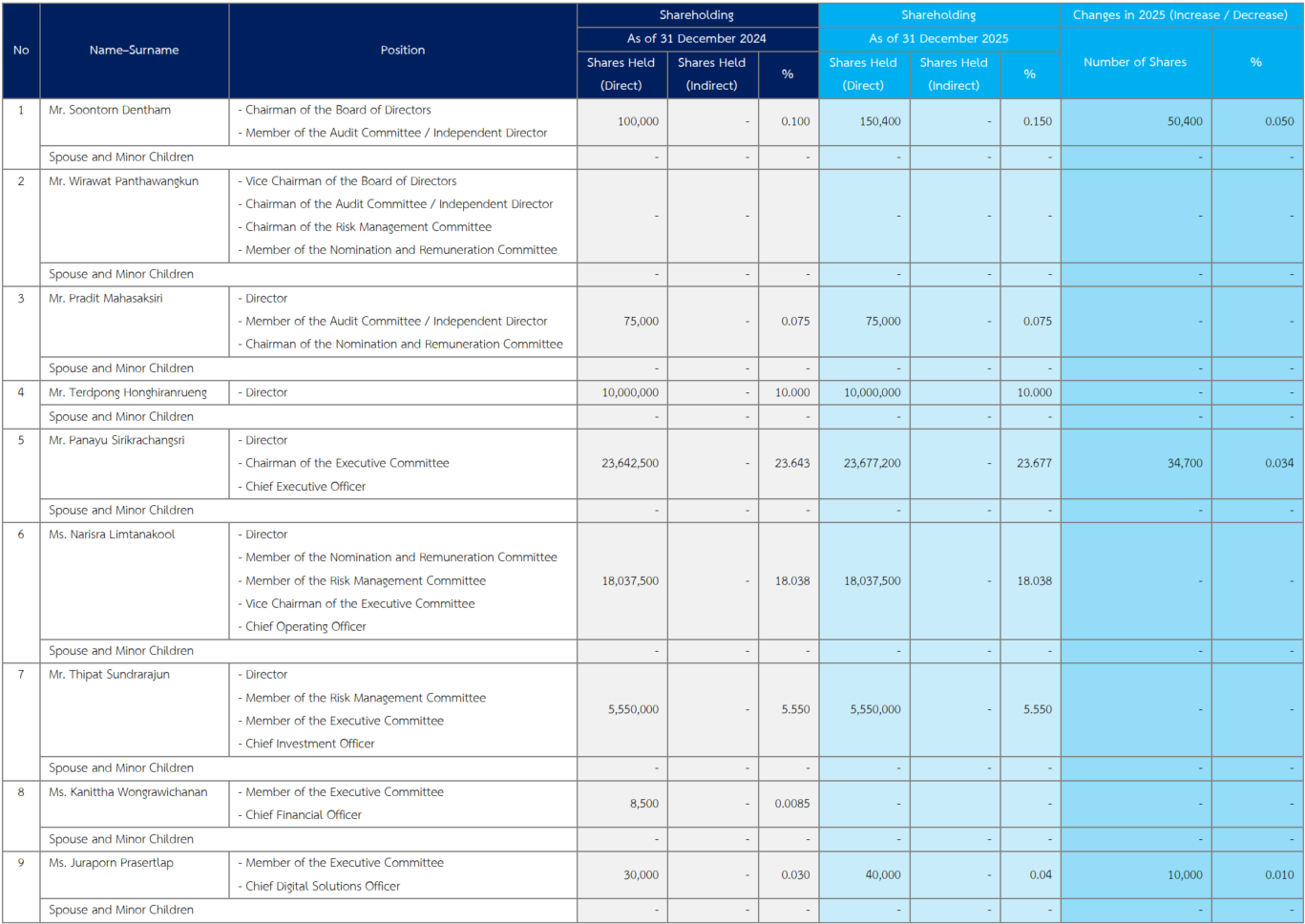 Note: Directors and executives do not hold indirect shares through spouses and minor children.
Number of Inside-Information Cases — Introduction
In 2025, the Company had no instances where the Company, its directors, or executives were fined, accused, or subject to civil action by regulatory bodies, namely the SEC and the SET, concerning unfair practices or exploitation of investors through the use of inside information by the Company's directors, and unfair practices or exploitation of investors through the use of inside information by the Company's executives.
Number of Inside-Information Cases
| Metric | Current Year | Previous Year | Two Years Ago |
|---|---|---|---|
| Total number of cases or issues related to the use of inside information to seek benefits (cases) | 0 | 0 | 0 |
Anti-Corruption
Has the Company Acted on Anti-Corruption?
Yes
Operations in the Past Year
The Company places great importance on anti-corruption and is aware of the potential impacts on the organization and stakeholders. Therefore, it has clearly defined an anti-corruption policy, declaring its intention not to tolerate any form of corruption, both direct and indirect.
The Company requires directors, executives, and employees of the Company, its subsidiaries, associates, and other companies over which the Company has control, as well as business representatives or any person acting for the benefit of the Company or on its behalf, without exception, to strictly comply with laws, regulations, policies, requirements, and manuals related to anti-corruption, as well as good corporate governance principles and business ethics. Personnel at all levels must perform their duties with honesty, integrity, transparency, and accountability, refraining from any acts that suggest fraud or corruption, and are prohibited from soliciting, offering, promising, giving, or accepting any inappropriate assets or other benefits to obtain or retain business, or to gain a competitive advantage, including for personal, family, or related party benefits. The Company is ready to cooperate and allow inspections by relevant authorities at all times.
The Company has disclosed the said policy as detailed in Section 2, Corporate Governance Policy. Topic 6.1.2 Policies and Practices and measures related to shareholders and stakeholders. Further details on the corporate governance policy and business ethics can be found on the Company's website: https://investor.tbn.co.th/cpg/cpg_home?menu=TAKE_CARE_INFO_MENU7
In 2025, the Company continues to prioritize and adhere to anti-corruption practices, while promoting transparent business operations and upholding ethical principles. The anti-corruption performance can be summarized as follows:
1. Participation in projects related to anti-corruption.
The Company has renewed its declaration of intent to join the Thai Private Sector Collective Action against Corruption (CAC) to demonstrate its commitment to anti-corruption and reinforce its stance on conducting business transparently and with good governance.
The Company has prepared a self-assessment form on anti-corruption measures according to specified criteria and submitted it to the Thai Private Sector Collective Action Against Corruption (CAC) Committee for consideration. The CAC Committee meeting resolved to certify the Company as a member of the Thai Private Sector Collective Action Against Corruption (CAC Certified), effective from September 30, 2025, for a period of 3 years.
The Company has elevated its anti-corruption efforts with an additional goal of requiring key business partners directly engaged with the Company to have anti-corruption policies, including monitoring and evaluating their compliance with these policies.
The Company has also demonstrated its stance by campaigning and requesting cooperation from business partners and alliances to "refrain from giving and receiving" gifts to the Company's executives and employees during various festivals and occasions annually, to reduce expenses and promote business operations based on principles of good governance, integrity, transparency, and fairness. Additionally, the Company continuously emphasizes its No Gift Policy to foster good awareness and values in the performance of duties for executives and employees at all levels, ensuring adherence to the principle of not giving or receiving gifts, presents, or any other benefits during all festivals and special occasions.
2. Verification of the completeness and adequacy of processes by the Audit Committee or auditors.
The Company conducts an annual self-assessment of the adequacy of its internal control system, which is reviewed and approved by the Audit Committee and then submitted to the Board of Directors for approval.
The Company conducts internal audits quarterly according to the audit plan, performed by internal auditors and external auditors, to assess compliance with anti-corruption policies and processes, and reports the results to the Audit Committee and the Board of Directors.
3. Monitoring and evaluating compliance with anti-corruption policies.
The Company regularly monitors and reports on its anti-corruption performance in its annual report (Form 56-1 One Report).
Monitoring reports and statistics on whistleblowing regarding policy or business ethics violations and corruption are regularly presented to the Audit Committee and the Board of Directors meetings every quarter.
4. Assessment and identification of corruption risks.
The Company has established a risk management process starting from identifying both internal and external risk factors, assessing and analyzing significant risks, developing contingency and prevention plans for each risk, and assigning responsible persons to manage identified risks to an acceptable level. This covers strategic planning, investment, and operational processes in all aspects, including
anti-corruption. The Company has established a risk management process starting from identifying both internal and external risk factors, assessing and analyzing significant risks, developing contingency and prevention plans for each risk, and assigning responsible persons to manage identified risks to an acceptable level. This covers strategic planning, investment, and operational processes in all aspects, including anti-corruption.The Company recognizes that risk management is a crucial mechanism for enhancing organizational stability and sustainability. Therefore, it consistently identifies and assesses factors that may affect its business, financial position, and operational performance, including risks that could lead to fraud or corruption in operational processes, particularly risks related to interactions with government agencies.
The Company will review the effectiveness of existing control measures and implement additional measures as necessary to ensure appropriate and sufficient internal control systems.The Company requires an assessment of corruption risks and internal audits at least once a year, covering high-risk departments and processes such as procurement, marketing, sales, and other related activities.
In cases where significant issues affecting operational processes or causing damage to the Company and stakeholders are found, the Internal Audit Department shall immediately report the audit results to senior management and report the audit results to the Board of Directors at least once a year, as well as supervise and monitor the implementation of specified improvement guidelines and clearly define preventive measures against recurrence.
5. Review of the appropriateness of anti-corruption matters.
In 2025, the Board of Directors meeting approved the review and amendment of anti-corruption policies and practices to ensure that the Company has appropriate and sufficient internal control systems to prevent and manage corruption risks.
The meeting approved the Company to conduct an assessment of corruption risks and to arrange for internal audits at least once a year, covering high-risk departments and processes such as procurement, marketing, sales, and other operations related to corruption risks.
Establish clear guidelines and review the anti-corruption policy at least once a year to ensure that directors, executives, and employees genuinely adhere to the policy and do not engage in any actions that lead to corruption or the giving or receiving of bribes.
6. Communication and training for employees on anti-corruption policies and practices.
The Company arranges for communication and dissemination of anti-corruption policies and practices through appropriate training, meetings, or various activities to directors, executives, and employees at all levels, subsidiaries, associates, other companies under the Company's control, business partners, intermediaries or representatives of the Company, and external stakeholders, including suppliers, business alliances, and the public throughout the supply chain. A summary of operations in 2025 is as follows:
The Company organized a presentation during the Board of Directors meeting to provide knowledge and review policies and practices related to anti-corruption measures, including relevant laws and regulations, to enhance understanding of the risks and penalties of fraud and giving or receiving bribes, as well as to reinforce the roles, duties, and responsibilities of directors in corporate governance in accordance with established criteria. All directors attended the presentation and policy review, accounting for 100 percent of the total number of directors.
The compliance officer has developed e-Learning materials with post-learning assessments for all senior executives to enhance their knowledge and understanding of anti-corruption practices and the giving or
accepting bribes. All senior executives participated in the learning and successfully passed the test, accounting for 100 percent of the total number of senior executives.The compliance officer has developed e-Learning materials with post-learning assessments for all employees to enhance their knowledge and understanding of anti-corruption practices and the giving or receiving of bribes. All employees participated in the learning and successfully passed the test, accounting for 100 percent of the total number of employees.
To ensure comprehensive communication and dissemination of policies and practices related to anti-corruption measures, the compliance officer has disseminated relevant policies and practices through the TBN PM system, which is the Company's internal communication system, to enable directors, senior executives, and employees to access information conveniently and continuously.
To ensure continuous compliance with policies and practices related to anti-corruption measures, the Company has assigned the compliance officer, in collaboration with the Human Resources Department, to communicate and build understanding among senior executives and employees. The Human Resources Department is tasked with communicating relevant policies and practices via e-mail to ensure that these individuals are aware and strictly adhere to them.
The Company Secretary is responsible for monitoring and communicating policies and practices related to anti-corruption measures to the Board of Directors, subsidiaries, and joint ventures via e-mail to ensure awareness of policy and practice reviews or amendments as mentioned when changes occur.
Form of Anti-Corruption Operations
| Operation |
|---|
| The participation in anti-corruption projects |
| Assessment and identification of corruption risk |
| Communication and training for employees on anti-corruption policy and guidelines |
| The monitoring of the evaluation of compliance with the anti- corruption policy |
| Review of the completeness and adequacy of the process by the Audit Committee or auditor |
| Review of appropriateness in anti-corruption |
Number of Corruption Cases — Introduction
In 2025, the Company found no complaints or whistleblowing reports regarding violations or non-compliance with its anti-corruption policy. Furthermore, the Company's directors have not been subject to any news, fines, accusations, or civil proceedings by regulatory bodies such as the Securities and Exchange Commission (SEC), the Stock Exchange of Thailand (SET), or the National Anti-Corruption Commission (NACC) concerning fraudulent activities.
Number of Corruption Cases
| Metric | Current Year | Previous Year | Two Years Ago |
|---|---|---|---|
| Total number of cases or issues related to corruption (cases) | 0 | 0 | 0 |
Whistleblowing
Has the Company Implemented Whistleblowing Procedures?
Yes
Operations in the Past Year
The company is committed to conducting business with integrity and ethics, as well as strictly adhering to relevant laws and regulations.
The company expects its directors, executives, employees, and stakeholders, including its subsidiaries, to uphold and comply with these principles. Accordingly, the Company has implemented a Whistleblowing Policy as a channel through which directors, executives, employees, staff, and stakeholders may file complaints or report any misconduct, including fraud and corruption, by any person against the Company. The company will protect and ensure fairness to individuals who report information or provide clues about corruption or non-compliance with laws, regulations, company bylaws, and the code of conduct in the business operations of the company, its subsidiaries, associates, and other companies over which the company has control.
Furthermore, Whistleblowing operations are a crucial mechanism that enables the company to promptly acknowledge and address inappropriate behavior or misconduct within the organization, such as corruption, legal violations, insider trading, human rights abuses, or unfair practices. This process significantly contributes to promoting transparency, accountability, and a positive organizational culture, while also helping to mitigate risks that may arise from inappropriate actions within the organization.
Whistleblowing operations in 2025 can be summarized as follows:
To further enhance the effectiveness of reporting misconduct, the Board of Directors meeting approved the review and amendment of the Whistleblowing Policy, aiming to expedite the complaint handling period. The investigation period for facts after receiving a complaint has been reduced from 30 days to 15 days, and the period for notifying the outcome of the complaint has been reduced from 15 days to
7 days.To ensure comprehensive communication and dissemination of policies and practices related to whistleblowing, the compliance officer has disseminated the relevant policies and practices through the TBN PM system, which is the company's internal communication system, to enable directors, senior executives, and employees to access information conveniently and continuously.
The company regularly reports on its whistleblowing performance in its annual report (Form 56-1 One Report) every year.
Reports on monitoring and statistics of whistleblowing regarding policy or business ethics violations, and fraud and corruption, are regularly submitted to the Audit Committee meeting and the Board of Directors meeting every quarter.
Regularly review whistleblowing policies and processes to align with changing laws and business environments.
The company has disclosed whistleblowing measures and the process for managing tips and complaints, as well as the aforementioned policies, as detailed in Section 2, Corporate Governance Policy. Topic 6.1.2 Policies and Practices and measures concerning shareholders and stakeholders Further details on the Corporate Governance Policy and Business Code of Conduct can be found on the company's website:
https://investor.tbn.co.th/cpg/cpg_home?menu=TAKE_CARE_INFO_MENU4
Number of Whistleblowing Cases — Introduction
In 2025, the Company did not identify any instances of misconduct, nor did it receive any reports or complaints concerning violations of its corporate governance policy or business ethics.
Number of Whistleblowing Cases
| Metric | Current Year | Previous Year | Two Years Ago |
|---|---|---|---|
| Total number of cases or issues received through whistleblowing channels (cases) | 0 | 0 | 0 |
Selection of Directors & Chief Executives
Selection, Development & Evaluation — Introduction
The Company places importance on the recruitment, development, and performance evaluation of the Board of Directors, both collectively and individually, as the Board of Directors has significant roles, duties, and responsibilities in setting strategies and business guidelines for sustainable growth.
Selection — Introduction
Recruitment and appointment of senior executives
The Nomination and Remuneration Committee is responsible for ensuring the recruitment and development of the Chief Executive Officer and senior executives possess the necessary knowledge, skills, experience, and qualifications to drive the organization towards its goals, and regularly review the succession plan for senior executives. Additionally, they evaluate performance and consider appropriate remuneration for top executives, and present it to the Board of Directors' meeting for approval.
Consideration for the appointment of new directors
In 2025, the Company has no new directors. However, the Company has proceeded with the guidelines for the nomination and appointment of directors in accordance with good corporate governance principles, with a summary of details as follows:
1. Nomination and Remuneration Committee Qualified individuals for the position of company director have been sought in accordance with relevant laws and regulations, to be proposed to the Board of Directors and the Annual General Meeting of Shareholders for 2025. The Company has provided an opportunity for shareholders to nominate individuals for election as company directors in advance. Between November 29, 2024, and January 15, 2025 However, No shareholder nominated any person for consideration as a director.
2. In 2025, the Board of Directors excluding directors nominated for this term, has considered approved Based on the opinion and recommendation of the Nomination and Remuneration Committee, by allowing to propose to the shareholders' meeting for approval of the appointment of directors who are due to retire in 2025, after the conversion to a public limited company, allowing the existing directors to be re-appointed as directors of the Company for another term. namely
Mr. Soontorn Dentham, Chairman Company Director / Audit Committee / Independent Director
Dr. Narisra Limtanakool, Company Director / Authorized Signatory Director / Nomination and Remuneration Committee / Risk Management Committee
In this regard, the consideration was conducted in accordance with the relevant criteria. It was determined that both directors possess qualifications that fully comply with the applicable requirements and are suitable for the Company’s business operations in terms of their knowledge, capabilities, and beneficial experience. Furthermore, they are able to devote sufficient time to perform their duties and do not possess any prohibited characteristics as prescribed by law.
In the case of Mr. Soontorn Dentham who has been nominated to serve as an independent director for another term. The Board of Directors has considered and determined that possesses qualifications fully complies with relevant laws regarding the requirements for independent directors and serves as an independent director according to the Company's definition of independent director qualifications.
Directors & Chief Executives — Introduction
Criteria, process for recruitment, and appointment of directors
The Nomination and Remuneration Committee is responsible for establishing criteria and policies for the recruitment and the process for recruiting suitable individuals to serve as directors, by selecting qualified individuals, taking into account diversity (Board Diversity) in terms of knowledge, expertise, skills, and experience beneficial to the company's business operations and consistent with the company's business strategies (Board Skill Matrix), without limitation based on gender, race, religion, age, and other specific characteristics, and must be individuals who are prepared to fully dedicate their time to performing their duties as directors, and do not possess prohibited characteristics as stipulated by law and good corporate governance principles.
When a director position becomes vacant, the Nomination and Remuneration Committee shall consider and screen suitable candidates for nomination as directors and submit their recommendations to the Board of Directors and/or the Shareholders' Meeting for consideration and approval of the appointment of such individuals as directors.
In addition, opportunities are provided for minority shareholders to nominate individuals for consideration and election as directors at the Annual General Meeting of Shareholders. The criteria for consideration shall be in accordance with the company's policies, articles of association, charter, and relevant laws, including the use of a director database (Director Pool) for consideration in recruiting new directors, and to protect the rights of minority shareholders, the Company will arrange for the individual appointment of directors to be voted on at the Company's Shareholders' Meeting.
Qualifications of Directors
1. Be individuals with knowledge, skills, expertise, abilities, education, both female and male, and experience that will benefit the business operations to ensure diversity in the board structure, possess integrity, business ethics, and sufficient time to fully dedicate their knowledge, abilities, and duties to the company. Additionally, they must possess qualifications consistent with the company's business strategies.
2. Possess full qualifications and not have prohibited characteristics under the Public Limited Company Act, the Securities and Exchange Act, and other relevant laws, and must not possess characteristics indicating a lack of suitability to be entrusted with the management of a business with public shareholders, as prescribed by the Securities and Exchange Commission (“SEC”)
3. Not engage in any business of the same nature that competes with the company's business, or become a partner or director of another legal entity of the same nature that competes with the company's business, whether for their own benefit or the benefit of others, unless the shareholders' meeting is informed before the resolution for appointment.
4. Directors must promptly inform the company if they have a direct or indirect interest in any contract made by the company, or if their shareholding in the company or its subsidiaries increases or decreases.
5. Independent directors must possess qualifications regarding independence as prescribed by the Capital Market Supervisory Board and must be able to equally protect the interests of all shareholders and prevent conflicts of interest. Furthermore, they must be able to attend Board of Directors meetings and provide independent opinions.
6. Must not serve as a director in more than 5 (five) other listed companies.
Appointment of Directors, Term of Office, and Cessation of Office of the Board of Directors
1. The appointment of directors shall be in accordance with the Company’s Articles of Association and applicable laws. The nomination process must be conducted with transparency and clarity. In considering candidates, due regard shall be given to their educational background, professional experience, qualifications, and the absence of any prohibited characteristics, supported by sufficient information for consideration. The Nomination and Remuneration Committee shall nominate individuals who possess qualifications in accordance with those specified in this Charter for submission to the Board of Directors and the shareholders for further consideration and appointment.
2. Directors shall hold office for a term of 3 years from the date of appointment or according to the term of office for company directors. Directors who retire by rotation may be nominated and re-appointed to a new term.
3. At every annual general meeting, at least one-third (1/3) of the company's directors shall retire from office. If the number of directors cannot be divided exactly into three parts, the number closest to one-third (1/3) shall retire. For the first and second years after the company's registration, the directors to retire shall be determined by drawing lots. In subsequent years, the director who has held office for the longest period shall retire. Directors who retire by rotation may be re-elected to their positions.
4. In addition to retirement by rotation, a director shall vacate office upon:
(a) Death
(b) Resignation
(c) Disqualified or possessing prohibited characteristics under the Public Limited Company Act and/or the Securities and Exchange Act, and/or possess characteristics indicating a lack of suitability to be entrusted with the management of a business with public shareholders, as prescribed by the SEC.
(d) The shareholders' meeting resolves to remove with a vote of not less than three-fourths (3/4) of the total number of shareholders attending the meeting and having voting rights, and holding shares totaling not less than half of the shares held by shareholders attending the meeting and having voting rights.
(e) Court order for removal
5. Any director wishing to resign from office before the completion of their term shall submit a letter of resignation to the Company. The resignation shall be effective from the date the letter of resignation reaches the Company. The resigning director may also inform the Registrar of Public Limited Companies of their resignation. Directors intending to resign should notify the Company in writing at least 1 month in advance, stating the reasons, so that the Board of Directors or the Shareholders' Meeting can consider appointing a qualified individual to fill the vacancy, and the Company shall inform the Stock Exchange of Thailand of the resignation.
6. In the event that the entire Board of Directors vacates office, the outgoing Board of Directors shall remain in an acting capacity to continue the company's operations only as necessary until the new Board of Directors assumes office (unless otherwise ordered by the court in cases where the Board of Directors vacates office due to a court order for removal). The outgoing Board of Directors must arrange for a shareholders' meeting to elect a new Board of Directors within 1 month from the date of vacating office, by sending a notice of meeting to shareholders at least 14 days before the meeting date.
7. In the event that a director position becomes vacant for reasons other than retirement by rotation, the Board of Directors shall select an individual who possesses qualifications and does not have prohibited characteristics as stipulated by the Public Limited Company Act and the Securities and Exchange Act, and does not possess characteristics indicating a lack of suitability to be entrusted with the management of a business with public shareholders as prescribed by the SEC, to serve as a replacement director at the next Board of Directors meeting, unless the term of office of such director is less than 2 months. An individual appointed as a replacement director in such a case shall hold office only for the remaining term of the director who vacated the position.
Criteria for the Recruitment of Senior Executives and Succession Plan
Criteria and methods for the recruitment of senior executives
1. The Board of Directors shall ensure that the recruitment of senior executives is fully qualified in terms of knowledge, skills, experience, and necessary attributes to drive the organization towards its set goals.
2. The Nomination and Remuneration Committee shall consider the criteria and methods for recruiting suitable individuals to serve as Chief Executive Officer, taking into account the knowledge, skills, and experience necessary for driving the organization at each period, specialized expertise related to the company's business, and communication and leadership abilities.
3. The Nomination and Remuneration Committee must collaborate with the Chief Executive Officer in considering the criteria and methods for recruiting and appointing senior executives, and should approve the individuals proposed by the Chief Executive Officer to hold top executive positions in the organization.
4. The Board of Directors must oversee and prepare a succession plan to prepare for the succession of senior executive positions in case of changes, to ensure business continuity.
5. The Board of Directors must establish policies and procedures for senior executives serving as directors in other companies, specifying the types of directorships and the number of companies in which they can serve, to prevent conflicts of interest and ensure no impact on their work in the principal company.
Senior Executive Succession Plan
The Company places importance on management To ensure business continuity, a succession plan is established important tasks as follows:
1. Establish a succession plan for the Chief Executive Officer, senior executives, and key positions in the company's core functions. etc. by considering the selection and evaluation of performance, potential, and qualifications of the company's personnel.
2. Establish criteria and methods for selecting successors to prepare for nomination and appointment as senior executives.
3. Arrange for the preparedness of individuals selected as successors by developing the necessary knowledge, abilities, skills, and experience for the position through job rotation in other relevant departments and undergoing additional essential training, in order to succeed in the position and be able to perform duties immediately when a vacancy arises.
4. Oversee the consideration of promotions and provide benefits for those selected as successors to create appropriate incentives.
5. Report the performance results according to the succession plan to the Board of Directors for acknowledgment at least once a year.
Report on Senior Executive Succession Plan
The Board of Directors has clearly defined policies and operational frameworks for the senior executive succession plan, and has assigned roles and responsibilities to the Chief Executive Officer to oversee and drive the implementation of the plan. It is stipulated that reports must be submitted at least once a year and whenever there are significant events or changes.
In 2025, the Chief Executive Officer reported on the progress of the succession plan for the positions of Chief Executive Officer and senior executives, a total of 1 time, to the Nomination and Remuneration Committee.
After receiving the report, the Nomination and Remuneration Committee considered the suitability, readiness of the successors, and alignment with organizational strategy, and reported to the Board of Directors for their opinion and acknowledgment of the progress of the senior executive succession plan.
Furthermore, Individual Development Plans (IDPs) for executives and employees identified as potential successors are reported to ensure that such personnel continuously develop the necessary knowledge, abilities, and experience, and can perform their duties effectively when a vacancy arises. This aims to ensure continuity in management and support the long-term stability of the organization.
Are Directors Selected Through the Nomination Committee?
Yes
Are Chief Executives Selected Through the Nomination Committee?
Yes
Number of Directors from Major Shareholders
4
Rights of Minority Shareholders on Director Appointment
Criteria and procedures for electing directors at the shareholders' meeting
1. Each shareholder shall have votes equal to the number of shares held, with one share having one vote.
2. In the election of directors, each shareholder must cast all votes according to item (1) to elect one or more individuals as directors. Votes cannot be split differently among individuals. Shareholders must cast their votes for each director individually, according to the list of nominees appearing on the ballot.
3. The individuals who receive the highest votes in descending order shall be elected as directors until the full number of directors to be appointed or elected for that occasion is reached. In the event that individuals in the subsequent order receive an equal number of votes exceeding the number of directors to be appointed or elected, the Chairman of the meeting shall have the casting vote.
Method of Director Appointment
| Method |
|---|
| Method whereby each director requires approval votes more than half of the votes of attending shareholders with voting rights |
Selection of Independent Directors
Introduction
The Company stipulates that the recruitment of independent directors must be conducted through a transparent process with clear criteria, in strict compliance with relevant laws, as well as the notifications and regulations of the Capital Market Supervisory Board. The Nomination and Remuneration Committee is entrusted with the responsibility of screening and selecting individuals who possess the appropriate qualifications, knowledge, competencies, and experience relevant to the Company's business operations. The nominated candidates are subsequently proposed to the Board of Directors for endorsement before being presented to the Shareholders' Meeting for appointment consideration, in accordance with legally prescribed procedures.
In evaluating candidates for independent directorships, the Company prioritizes their ability to perform duties independently, alongside their knowledge and expertise in fields beneficial to corporate governance. Furthermore, the Company places significant emphasis on Board Diversity—encompassing a wide array of skills, experiences, and perspectives—to elevate the efficiency of corporate governance and effectively support the formulation of the organization's strategic direction.
Individuals nominated as independent directors must fully meet the qualifications prescribed by the Company's criteria, the law on Securities and Exchange, and the notifications of the Capital Market Supervisory Board. They must be free of any legally prohibited characteristics. Additionally, they must possess the knowledge, capabilities, and experience beneficial to the Company's business operations, be able to dedicate sufficient time to fulfill their directorial duties, and be capable of performing their roles and expressing their opinions with absolute independence for the maximum benefit of the Company and its shareholders as a whole.
In this regard, the Company's independent directors must fulfill the qualifications outlined in the Company's definition of an independent director, which is strictly aligned with the criteria of the Capital Market Supervisory Board and other relevant regulations.
Criteria for Selecting Independent Directors
Criteria, Nomination Process, and Appointment of Directors
The Nomination and Remuneration Committee is responsible for establishing criteria and policies for the nomination and the process for selecting qualified individuals to serve as directors, by choosing suitable individuals, taking into account diversity (Board Diversity) in terms of knowledge, expertise, skills, and experience beneficial to the company's business operations and consistent with the company's business strategy (Board Skill Matrix), without discrimination based on gender, race, religion, age, and other specific characteristics. They must also be individuals who are willing to dedicate their time fully to their duties as directors and must not possess any prohibited characteristics under the law and good corporate governance principles.
When a director position becomes vacant, the Nomination and Remuneration Committee will screen qualified individuals for nomination as directors and submit their recommendations to the Board of Directors and/or the Shareholders' Meeting for consideration and approval of the appointment of such individuals as directors.
Furthermore, minority shareholders are given the opportunity to nominate individuals for consideration as directors at the Annual General Meeting of Shareholders, with the consideration criteria adhering to the company's policies, regulations, charter, and relevant laws, including the use of the director database (Director Pool) for consideration in nominating new directors. To protect the rights of minority shareholders, the company will arrange for the appointment of directors to be voted on individually at the company's shareholders' meeting.
Additional Qualifications of Independent Directors
In addition to the aforementioned qualifications for directors, independent directors must fully meet the qualifications specified by the company and comply with the announcements of the Capital Market Supervisory Board, as follows:
1. Holding shares not exceeding 1% of the total voting shares of the company, its parent company, subsidiaries, associated companies, major shareholders, or controlling persons of the company. This includes shares held by persons related to that independent director.
2. Not be or have been an executive director, employee, staff member, salaried advisor, or controlling person of the company, parent company, subsidiaries, associated companies, fellow subsidiaries, major shareholders, or controlling persons of the company, unless such characteristics have ceased for at least 2 years prior to the date of appointment.
3. Not be a person with a blood relationship or a legal relationship as a father, mother, spouse, sibling, or child.
including spouses of children of other directors, executives, major shareholders, controlling persons, or individuals proposed to be directors, executives or controlling persons of the company or its subsidiaries.
4. Not have or have had a business relationship with the company, its parent company, subsidiaries, associated companies, major shareholders, or controlling persons in a manner that may impede their independent judgment, and not be or have been a significant shareholder or controlling person of a party having a business relationship with the company, its parent company, subsidiaries, associated companies, major shareholders, or controlling persons of the company, unless such characteristics have ceased for at least 2 years prior to the date of appointment.
Business relationships as per the first paragraph include normal commercial transactions conducted for business operations, leasing or subleasing of real estate, transactions related to assets or services, or the provision or receipt of financial assistance through borrowing, lending, or guarantees, the provision of assets as collateral for debts, including other similar circumstances, resulting in the company or counterparty having a debt obligation to the other party of 3% or more of the company's net tangible assets, or 20 million baht or more, whichever is lower. The calculation of such debt obligations shall follow the method for calculating the value of connected transactions as stipulated by the Capital Market Supervisory Board's notification on rules for connected transactions, mutatis mutandis. However, when considering such debt obligations, debts incurred within 1 year prior to the date of the business relationship with the same person shall be included.
5. Not be or have been an auditor of the company, its parent company, subsidiaries, associated companies, major shareholders, or controlling persons of the company, and not be a significant shareholder, controlling person, or partner of an audit firm that has auditors of the company, its parent company, subsidiaries, or associated companies.
major shareholders or controlling persons of the affiliated company, unless such characteristics have ceased for at least 2 years prior to the date of appointment.
6. Not be or have been a professional service provider, including legal or financial advisors, who received service fees exceeding 2 million baht per year from the company, its parent company, subsidiaries, associated companies, major shareholders, or controlling persons of the company, and not be a significant shareholder, controlling person, or partner of such professional service provider, unless such characteristics have ceased for at least 2 years prior to the date of appointment.
7. Not be a director appointed as a representative of the company's directors, major shareholders, or shareholders related to major shareholders.
8 . Not engage in a business of the same nature that is significantly competitive with the company's or its subsidiaries' business, or not be a significant partner in a partnership, or be an executive director, employee, staff member, salaried advisor, or hold more than 1% of the total voting shares of another company that engages in a business of the same nature and is significantly competitive with the company's or its subsidiaries' business.
9. Possess no other characteristics that would prevent them from providing independent opinions on the company's operations.
10. Independent directors may serve for a maximum of 3 consecutive terms (not exceeding 9 years).
Business or Professional Relationships — Introduction
In 2025, the Company's independent directors have no business relationships or professional service relationships that would disqualify them and comply with the criteria specified in the Notification of the Capital Market Supervisory Board regarding the application for and approval of newly issued share offerings, as well as no independent directors have served beyond their specified term.
Did Any Independent Director Have a Business or Professional Relationship?
No
Director Development
Director Development — Introduction
Director and Executive Development
Director Development
1. New Director Orientation
The Company places great importance on the orientation of new directors to prepare individuals appointed as new directors. The orientation focuses on providing necessary information and knowledge for directors to perform their duties effectively. The Company has developed a Board Orientation Guideline, presenting important documents and information beneficial for new directors' performance. The orientation content covers an overview of the organization, business characteristics, rules and regulations related to the roles, duties, and responsibilities of directors, as well as in-depth information about the business and operations in various aspects such as finance, marketing, risk management, and sustainable development.
Furthermore, the Company also emphasizes providing knowledge and understanding of the business and operational processes in various dimensions to promote the readiness of new directors in effectively supporting the Company's operations.
2. Continuous development of directors' knowledge
The Company places importance on the continuous development of knowledge, abilities, and skills of directors and executives to enhance the efficiency of governance and management in line with good corporate governance principles, as well as relevant laws, rules, and practices. The Company supports participation in training and seminars from relevant organizations such as the Thai Institute of Directors Association, the Stock Exchange of Thailand, and the Securities and Exchange Commission, as well as other professional institutions and associations related to the roles and duties of directors and business development. This development helps to increase knowledge and experience, which is beneficial for strategy formulation, performance monitoring, and addressing business challenges and opportunities in the industry in which the Company operates.
In 2025, the Company continues to support directors in continuously attending training and seminar courses beneficial to their duties, to enhance their knowledge and understanding of good corporate governance principles, relevant rules and regulations, as well as the roles and responsibilities of directors.
3. Development of Chief Executive Officer and Senior Executives
The development of the Chief Executive Officer (CEO) and senior executives is considered a crucial investment in driving the organization's long-term success. Therefore, the Board of Directors emphasizes the development of senior executives in various aspects to enhance management efficiency and strengthen leadership skills to guide the organization towards its set goals, as follows:
1. The Company continuously establishes training and skill development plans for the CEO and senior executives, focusing on enhancing skills in organizational management, internal and external communication, risk management, and adapting to new business trends. Examples include training in Corporate Governance, ESG (Environmental, Social, and Governance) for sustainability, Change Management development, and communication and stakeholder relationship building skills.
2. The development of senior executives requires a clear succession plan to ensure business continuity in the event of changes in senior executive positions. The Company has established a comprehensive succession plan, covering both the development of high-potential executives and the preparation of individuals who may replace them in key positions in the future.
3. The Board of Directors supports the CEO and senior executives in participating in external activities or seminars to build networks and bring new ideas or knowledge to be applied within the organization. This strategic development can be achieved through participation in activities from relevant associations, senior executive meetings, or discussions and exchanges of opinions with external experts.
4. The Board of Directors promotes the development of the CEO and senior executives to possess knowledge and skills in sustainability management (especially in ESG, which is a crucial factor in today's business world and enhances the organization's long-term management potential). Concurrently, business practices can be adjusted to align with considerations for social and environmental impacts.
5. Board of Directors places importance on the development of CEO and senior executives continuously, to enhance their ability to manage the organization efficiently, in line with good corporate governance principles and sustainable development. to enhance knowledge and experience beneficial to their work, and to encourage participation in various training and seminar courses offered by the Thai Institute of Directors Association. the Stock Exchange of Thailand, associations, and other institutions that are relevant and beneficial to business development.
4. Employee Development Plan according to the Succession Plan
In 2025, the Company systematically implemented its Succession Plan, utilizing potential and performance evaluation tools through KPIs and the 9-Box Matrix to analyze and categorize personnel based on their performance and potential. This data serves as a basis for selecting successors for key positions within the organization, ensuring that the Company has suitable personnel ready to accommodate future changes.
The Company has developed Individual Development Plans (IDP) for executives and employees selected for
Succession plan, by defining development guidelines consistent with the necessary competencies for each position, covering knowledge, abilities, leadership skills, and relevant experience, such as job rotation in relevant departments, special project assignments to enhance strategic experience, as well as participation in additional necessary training programs.
The aforementioned approach aims to continuously and concretely develop personnel in the succession plan, ensuring they are prepared to perform duties effectively immediately when a vacancy arises, thereby creating continuity in management and reducing the risk of executive shortages.
Development of Directors in the Past Year
The Company encourages directors to attend training courses and seminars that are beneficial to their work performance, in order to enhance their knowledge and understanding of good corporate governance principles, rules, regulations, as well as their roles and responsibilities in effective management.
In 2025, directors attended training and participated in seminars, summarized as follows:
Qualifications for Director Selection — Introduction
Criteria for nominating individuals to be directors
A person nominated as directors according to criteria for granting shareholders the right to nominate individuals for consideration and election as company directors in advance at the Annual General Meeting of Shareholders must possess qualifications and not have prohibited characteristics as follows:
1. Be not more than 63 full years of age as at the date of nomination.
2. Possess the required qualifications and not have any prohibited characteristics under the Public Limited Companies Act, the Securities and Exchange Act, and any other applicable laws, notifications, regulations, or rules, as well as the Company’s corporate governance principles, and fully meet the qualifications and definition of an independent director.
3. Possess knowledge, ability, expertise, and experience that can benefit and are suitable for the nature of the Company's business, such as engineering, management and business administration, marketing, international business, accounting, finance, law, risk management, political science, economics, science and technology, and digital transformation, etc.
4. Able to perform duties as a director with due care and loyalty (Duty of Care and Duty of Loyalty), be independent, able to dedicate time fully, be of appropriate age, possess good physical health and mental well-being, be able to attend Board meetings regularly, prepare well in advance of meetings, contribute constructively to meetings, be straightforward, have the courage to express opinions in meetings, and/or be a reputable business person with a good work history and ethics, and be socially accepted.
5. Must not have conflicts of interest with the Company, namely:
5.1 Operate a business, or be a partner of any type, or be a director of another limited company or public company
that conduct the same business, businesses that compete with the Company's operations, and not be a contracting party with a vested interest in the Company.
5.2 Other cases as stipulated by the Public Limited Company Act and/or as prescribed by law.
6. Should not hold directorships in multiple limited companies or public companies simultaneously.
Qualifications for Director Selection
| Qualification | Skill & Expertise |
|---|---|
| Does not possess prohibited characteristics under the Public Limited Company Act, the Securities and Exchange Act, and other related laws, notifications, regulations, or criteria, as well as the company's good corporate governance principles, and fully meets the requirements and the definition of an independent director. | 141 · Description: Law · 146 · Description: Human Resource Management · 159 · Description: Engineering · 165 · Description: Risk Management · 1683 · Description: Business Administration |
Evaluation of Board & Subcommittee Performance
Criteria for Evaluating Board Performance
1. Evaluation of the Board of Directors and Sub-committees
Criteria for the overall evaluation of the Board of Directors and its sub-committees
In accordance with good corporate governance principles for listed companies, it is recommended that the Board of Directors and sub-committees of listed companies conduct self-performance evaluations at least once a year. This allows the Board to collectively review performance and make improvements. The essence of the evaluation will focus on the qualifications and suitability of directors, roles, duties, and responsibilities, relationships among board members, work efficiency, and the comprehensive performance of directors' duties.
The Board of Directors has assigned the Nomination and Remuneration Committee to establish criteria and evaluate the performance of the entire Board annually. The Company Secretary is to submit evaluation forms to the Board at the end of each year, at least once a year, and summarize the evaluation results, including reporting them to the Board of Directors' meeting for acknowledgment and joint discussion regarding comments, suggestions, and matters of interest to each director.
The annual performance evaluation of the Board of Directors aims to enhance the Board's efficiency and identify ways to improve its performance for the following year.
Overall evaluation process for the Board of Directors and sub-committees
The performance evaluation forms for the Board of Directors and sub-committees are merely guidelines for evaluation. They may be adjusted and modified to align with the nature or size of the business, as well as circumstances and issues deemed important by the Board. They are divided as follows:
1. Board of Directors Self-Performance Evaluation Form (entire Board): This form reflects each director's opinion on the overall performance of the entire Board of Directors, not an individual director evaluation, and the scores are weighted and averaged.
2. Sub-committee Self-Performance Evaluation Form (per committee): The sub-committee evaluates the overall performance of the entire sub-committee, and the scores are weighted and averaged.
3. Individual Director Self-Performance Evaluation Form: This form reflects each director's overall opinion on their own performance, serving as an individual director evaluation, with the evaluation scores being weighted and averaged.
The aforementioned performance evaluation form for the Board of Directors, which has been screened and approved by the Nomination and Remuneration Committee, and subsequently approved by the Board of Directors' meeting, encompasses an evaluation process covering 3 categories as follows:
1. Board Structure and Qualifications
2. Board Meetings
3. Roles, Duties, and Responsibilities of the Board of Directors
Score levels are divided into 5 levels:
1 means Very Poor (Strongly disagree, or very little action has been taken on the matter)
2 means Poor (Disagree, or little action has been taken on the matter)
3 means Fair (Agree, or reasonable action has been taken on the matter)
4 means Good (Quite agree, or good action has been taken on the matter)
5 means Excellent (Strongly agree, or excellent action has been taken on the matter)
The total scores obtained are then calculated as a percentage of the full score, with the following criteria:
Equal to or greater than 90% = Excellent
Equal to or greater than 80% = Very Good
Equal to or greater than 70% = Good
Equal to or greater than 60% = Fair
Less than 60% = Needs Improvement
Following the evaluation, the Board of Directors will collectively review and discuss the results to develop and improve the efficiency of the Board's performance, thereby supporting the company's long-term sustainable operations.
2. Performance Evaluation of the Chief Executive Officer
Criteria for evaluating the performance of the Chief Executive Officer
In accordance with good corporate governance principles, the Board of Directors, excluding executive directors, should play a role in determining the remuneration and evaluating the performance of the Chief Executive Officer to incentivize the management of the business in line with its objectives, key goals, strategies, and long-term interests. This is to promote and support the company in evaluating the performance of the Chief Executive Officer according to good corporate governance principles and practices, and to enhance the effectiveness of the Chief Executive Officer's duties by receiving perspectives, opinions, and suggestions from the Board of Directors, which can then be considered for addressing various problems and obstacles.
The Board of Directors mandates the performance evaluation of the Chief Executive Officer (CEO) annually. The evaluation is conducted by non-executive directors to ensure transparency and fairness, and the scores are weighted and averaged.
Performance evaluation process for the Chief Executive Officer
Evaluation of performance based on Key Performance Indicators (Corporate KPI) that covers current operational dimensions and long-term goals, in line with the principles of Balance Scorecard which is divided into 4 Key aspects include:
1. Financial Returns (Financial Performance): Revenue growth, net profit, reduction of operating costs, and return to shareholders (ROE).
2. Customer Management (Customer Perspective): Ability to formulate and make strategic decisions, expand customer base, customer satisfaction, build long-term relationships, and add value to customers.
3. Internal Process: Improving work process efficiency, efficient resource management, risk management, and compliance with laws and ethics.
4. Learning and Growth: Development of personnel skills and abilities, promotion of organizational culture, and creation of an environment that fosters learning and growth, including the proportion of employees who have undergone development.
Additionally, the performance evaluation CEO also covers in other important dimensions, such as Environmental, Social, and Governance (ESG) such as Environmental management, sustainability, promotion of social responsibility, and business operations with good governance, and economic value added (EVA) such as sustainable economic value creation, and maximizing resource utilization for optimal returns, among others.
by The evaluation results are used to determine the organizational performance indicators ( Corporate KPI) and serves as information for developing the potential of CEO in the long term. The performance evaluation process is divided into 3 Key components include:
1. Measurement of Goal Achievement: Evaluate actual financial performance results against the established targets.
2. Performance Measurement: Evaluate operational capability, decision-making, internal processes, and management to measure the management efficiency of CEO, considering performance measurement criteria, divided into 12 aspects as follows:
(1) Leadership
(2) Strategy Formulation
(3) Strategy Implementation
(4) Financial Planning and Performance
(5) Relationship with the Board of Directors
(6) External Relations
(7) Management and Personnel Relations
(8) Succession Planning
(9) Knowledge of Products and Services
(10) Personal Attributes
(11) Economic Value Added: Economic Value Added (EVA)
(12) Environmental, Social, and/or Governance: Environmental, Social, Governance (ESG)
Performance evaluation score level of CEO is divided into 5 levels:
1 means Very Poor (Strongly disagree, or very little action has been taken on the matter)
2 means Poor (Disagree, or little action has been taken on the matter)
3 means Fair (Agree, or reasonable action has been taken on the matter)
4 means Good (Quite agree, or good action has been taken on the matter)
5 means Excellent (Strongly agree, or excellent action has been taken on the matter)
The total scores obtained are then calculated as a percentage of the full score, with the following criteria:
Equal to or greater than percentage 90 = Excellent
Equal to or greater than percentage 80 = Very Good
Equal to or greater than percentage 70 = Good
Equal to or greater than percentage 60 = Fair
Less than percentage 60 = Needs Improvement
3. Development of the potential of CEO: Assess the development of skills, capabilities, and leadership potential in driving the organization forward.
Evaluation of Board Performance in the Past Year
1. Summary of the Performance Assessment of the Board of Directors and Sub-Committees
In 2025, the Board of Directors considered and approved the self-assessment form for the Board of Directors and sub-committees according to the process. This assessment form has been reviewed and approved by the Nomination and Remuneration Committee to ensure its suitability, comprehensive coverage of roles and responsibilities, and alignment with good corporate governance principles.
After approval, the Company Secretary is responsible for distributing the assessment forms to all directors for annual self-assessment, as well as compiling and summarizing the assessment results to present a report to the Board of Directors' meeting for acknowledgment and discussion of feedback, recommendations, and additional issues to be emphasized.
Upon completion of the assessment process, the Board of Directors will systematically review the assessment results, analyzing strengths, areas for development, and various recommendations to establish guidelines for improving performance at both individual and overall board levels. Clear action plans will be defined, and progress will be regularly monitored. This is to utilize the assessment results for developing the Board's operational efficiency, as well as to revise criteria and assessment forms to be appropriate and consistent with the company's operational context in the following year, thereby supporting the company's efficient operations.
Overall Results of the Self-Assessment of the Board of Directors and Sub-Committees
Overall Assessment Results | Year 2024 | Year 2025 | ||
Average Score (%) | Criteria Assessment | Average Score (%) | Criteria Assessment | |
Individual Self-Assessment of Performance | 91.95 | Excellent | 91.95 | Excellent |
Self-assessment of the entire Board of Directors | 94.55 | Excellent | 93.46 | Excellent |
Self-assessment of Sub-committee Performance | 93.96 | Excellent | 97.47 | Excellent |
1. Audit Committee | 91.67 | Excellent | 92.33 | Excellent |
2. Nomination and Remuneration Committee | 98.60 | Excellent | 98.60 | Excellent |
3. Risk Management Committee | 92.22 | Excellent | 97.78 | Excellent |
2. Summary of Measurement Results according to the Chief Executive Officer's performance assessment form
In 2025, the Board of Directors considered and approved the Chief Executive Officer's performance assessment form. This assessment form has been reviewed and approved by the Nomination and Remuneration Committee. The assessment is conducted in accordance with the policy and criteria for the recruitment and remuneration of the Chief Executive Officer and senior executives, taking into account their duties and responsibilities.
responsibilities, and the company's performance compared to the defined goals and indicators.
In this assessment, the Company Secretary is responsible for submitting the assessment form to the non-executive directors to evaluate the Chief Executive Officer, considering the established policies and guidelines, as well as performance results, including problems and obstacles that may prevent operations from achieving their objectives, for the Board of Directors' acknowledgment and comprehensive consideration.
Upon completion of the assessment process, the Company Secretary will compile and summarize the assessment results and present them to the Board of Directors' meeting for consideration and approval of the appropriate adjustment rate for the Chief Executive Officer's remuneration. Additionally, recommendations from the Board of Directors, which have assessed and provided feedback on the Chief Executive Officer's potential development, will be discussed and used as supporting information for continuous improvement and development of performance. This is to enhance management efficiency, support the achievement of the company's strategic goals, and encourage the Chief Executive Officer to develop skills, abilities, and potential to lead the organization. towards effective achievement of set goals.
Results of the Performance Assessment of Chief Executive Officer
Performance Assessment Results of Chief Executive Officer | Year 2024 | Year 2025 | ||
Average Score | Assessment Result Level | Average Score | Assessment Result Level | |
Overall Average Performance Assessment Results | 93.88 | Excellent | 92.01 | Excellent |
1. Measurement of Goal Achievement | 72.50 | Good | 70.00 | Good |
2. Performance Measurement | 94.54 | Excellent | 92.69 | Excellent |
3. Potential development of CEO | The Board of Directors (non-executive directors) provided open-ended feedback regarding the potential development of CEO regarding key strengths and areas where the CEO should be developed, to serve as information for continuous improvement and development of the CEO's performance. | The Board of Directors (non-executive directors) provided open-ended feedback regarding the potential development of CEO regarding key strengths and areas where the CEO should be developed, to serve as information for continuous improvement and development of the CEO's performance. | ||
Evaluation Results
| Evaluated Body | Group — Carried Out? | Group — Grade / Average Score | Group — Grade / Full Score | Individual (Self-Assessment) — Carried Out? | Individual (Self-Assessment) — Grade / Average Score | Individual (Self-Assessment) — Grade / Full Score | Cross (Assessing Other Directors) — Carried Out? |
|---|---|---|---|---|---|---|---|
| Board Of Director | Y | 93.46% | 5 | Y | 91.95% | 5 | N |
| Audit Committee | Y | 92.33% | 5 | Y | 91.95% | 5 | N |
| Other Subcommittee | Y | 98.60% | 5 | Y | 91.95% | 5 | N |
| Other Subcommittee | Y | 97.78% | 5 | Y | 91.95% | 5 | N |
Subcommittees
Subcommittees
| Results of the Subcommittee's Duty Performance | Meetings — Introduction |
|---|---|
Risk Management Policy and Framework The Risk Management Committee performs its duties under the Company’s enterprise risk management policy and the principles of good corporate governance, with a focus on identifying, assessing, monitoring, and managing risks within acceptable levels. The scope of risk management covers all key risk dimensions, including strategic, operational, financial, legal and regulatory compliance, social and environmental risks, as well as emerging risks. In this regard, the Risk Management Committee supports the use of appropriate risk management tools, such as a standard risk map, key risk indicators (KRIs), and the development of forward-looking risk management plans, in order to enhance the effectiveness of systematic risk monitoring and management. 1. Review and Monitoring of Risk Management Plan Implementation In 2025, the Risk Management Committee continuously reviewed and monitored the implementation of the Company’s risk management plan, integrating risk management into the strategic formulation, planning, and business operations at all levels of the organization, in order to support the achievement of objectives and sustainable growth. The Committee regularly monitored changes in risk levels and the effectiveness of control measures. Where risks that could affect business operations were identified, recommendations were provided to enhance risk management measures, including the establishment of appropriate mitigation and contingency actions. Particular emphasis was placed on the assessment of emerging risks arising from changes in technology, laws, regulations, and environmental issues, to ensure that risk management remains aligned with the evolving business context. 2. Consideration of the Risk Management Plan The Risk Management Committee considered and approved the enterprise risk management plan for the year 2025 under the Company’s risk management policy. The plan was developed in alignment with the Company’s strategies, business objectives, and risk context, and covers all significant risk dimensions, including strategic, operational, financial, legal and regulatory compliance, social and environmental risks, as well as emerging risks. In its consideration of the plan, the Committee placed emphasis on the systematic linkage between risks and the Company’s strategies, the designation of risk owners, the determination of risk appetite, and the establishment of appropriate control measures. This approach ensures that the risk management plan serves as an effective framework for monitoring, performance evaluation, and supporting strategic decision-making by management and the Board of Directors. 3. Monitoring and Acknowledgement of Risk Management Plan Implementation Throughout 2025, the Risk Management Committee monitored and acknowledged the results of the implementation of the risk management plan based on reports from management, the use of key risk indicators, and comparisons between actual risk levels and the Company’s risk appetite. This was undertaken to assess the adequacy and effectiveness of the risk management system in practice. The monitoring results indicated that significant risks across all dimensions, namely strategic, operational, financial, legal and regulatory compliance, social and environmental risks, as well as emerging risks—were managed appropriately, and no risk issues were identified that had a material impact on the Company’s business operations. In this regard, the Committee placed particular emphasis on overseeing technology-related and sustainability-related risks, as well as closely monitoring emerging risks, to ensure that the Company’s risk management system remains resilient and well-prepared for long-term changes. 4. Review of the Risk Management Committee Charter The Risk Management Committee regularly reviews the Risk Management Committee Charter at least once a year to ensure that its roles, authority, and responsibilities remain appropriate, up to date, and aligned with the Company’s business direction, corporate strategy, and risk appetite. The review of the Charter covers key matters, including aligning risk oversight with the Company’s strategy and business growth, placing emphasis on emerging risks—particularly information technology risk, cybersecurity, personal data protection, and sustainability-related risks—as well as reviewing reporting processes and coordination with the Audit Committee and management. This is to support the effective and systematic implementation of enterprise risk management (ERM) across the organization. Based on such review, the Risk Management Committee is of the opinion that the Risk Management Committee Charter is comprehensive, appropriate, and in compliance with applicable regulatory requirements and good practices. The Charter serves as an effective framework for overseeing and driving the Company’s risk management system with clarity and transparency, while enhancing organizational resilience to support long-term sustainable growth and adaptability to change. 5. Performance Evaluation of the Risk Management Committee In 2025, the Risk Management Committee conducted an annual performance assessment as a mechanism to review the effectiveness of its duties and to use the assessment results for the continuous development and improvement of the Committee’s operations. The assessment process comprised three levels: (1) a collective assessment of the Committee as a whole, (2) an assessment of each subcommittee, and (3) individual self-assessments of Committee members, in accordance with good corporate governance practices. Overall, the assessment results indicate that the Risk Management Committee has performed its duties appropriately and responsibly, in accordance with the roles and responsibilities set out in the Charter. The Committee has also utilized the assessment results and related recommendations to establish development guidelines and further enhance the effectiveness of enterprise risk oversight, in order to support the Board of Directors’ strategic decision-making and the Company’s long-term sustainable business operations. Summary of the Committee’s Opinion For the year 2025, the Risk Management Committee is of the opinion that the Company has a clear, comprehensive, and effective risk management system that is adequate to support business operations amid external volatility. The Company is able to manage risks within acceptable levels and appropriately monitor emerging risks, thereby enhancing organizational preparedness and creating sustainable value for shareholders and all stakeholder groups. | TBN Corporation Public Company Limited (the “Company”) places strong emphasis on enterprise risk management as a key mechanism supporting the achievement of its strategic objectives, sustainable business operations, and good corporate governance. Accordingly, the Board of Directors has appointed a Risk Management Committee and clearly defined its roles, responsibilities, and scope of authority in the Risk Management Committee Charter. The Risk Management Committee consists of 3 directors. In 2025, the Committee held a total of 2 meetings to consider, oversee, and monitor the Company’s risk management activities in accordance with the approved risk management policy and framework, and to report the outcomes to the Board of Directors within the scope of its assigned duties. The names of the directors, their positions, and meeting attendance records are as follows: |
The Nomination and Remuneration Committee has carried out its duties and responsibilities within its prescribed scope. The key aspects of its performance during the year can be summarized as follows: 1. Nomination Process 1.1 Recruitment and Selection of Directors The Nomination and Remuneration Committee conducted the nomination and selection of individuals for appointments as directors of the Company and members of sub-committees, based on the principles of transparency, fairness, and suitability in line with the Company’s business operations. The candidates considered did not possess any prohibited characteristics under applicable laws. Such consideration was carried out in compliance with relevant laws, rules, and regulations, including the requirements of the Securities and Exchange Commission (the “SEC”) and the Stock Exchange of Thailand (the “SET”). The Committee considered the qualifications of the nominated candidates in terms of knowledge, competence, experience, independence (in the case of independent directors), integrity, ethics, and the appropriateness of the Board structure. A Board Skills Matrix was utilized as a supporting tool to ensure that the Board possesses skills and expertise aligned with the Company’s strategy and business direction. In 2025, the Company provided shareholders with the opportunity to propose candidates for consideration for election as directors in advance, during the period from November 29, 2024, to January 15, 2025. However, no shareholder submitted any nominations for consideration. Accordingly, the Committee proposed to the 2025 Annual General Meeting of Shareholders for consideration and approval the re-election of two directors retiring by rotation, namely Mr. Soontorn Dentham and 1.2 Orientation for New Directors In 2025, the Company did not appoint any new directors. However, the Nomination and Remuneration Committee has established standardized guidelines and procedures for the orientation of newly appointed directors to ensure that future appointees are provided with necessary information and are adequately prepared to perform their duties effectively. The orientation program will cover key information regarding the Company’s organizational overview, nature of business, management structure, and relevant rules and regulations governing the roles, duties, and responsibilities of directors, as well as in-depth operational information across various dimensions, including finance, risk management, and sustainability development. This is intended to support newly appointed directors effectively and appropriately contributing to the Company’s corporate governance. 1.3 Succession Planning The Committee considered and established a succession plan by reviewing the Company’s succession planning policy to ensure clearer and more systematic oversight of succession planning and executive development plans. In 2025, the Committee assigned the Chief Executive Officer to oversee the development of high-potential personnel through a transparent and fair selection process, with progress reported to the Board of Directors at least once a year. The Committee also continuously monitored and evaluated succession plans for senior management and key positions to enhance management continuity, mitigate strategic risks, and support the Company’s long-term stability and sustainability. 2. Remuneration Determination 2.1 Determination of Remuneration for the Board of Directors and Sub-Committees The Nomination and Remuneration Committee carefully considered and reviewed the remuneration policies and criteria for the Board of Directors and sub-committees, based on the principles of transparency, appropriateness, and fairness, to ensure alignment with the roles, duties, and responsibilities assigned. In addition, the Committee conducted benchmarking of remuneration levels against companies in the same industry with comparable business size, together with consideration of prevailing economic conditions, In 2025, the Committee proposed a total remuneration framework not exceeding THB 1.8 million, which was approved by the Annual General Meeting of Shareholders. Executive directors and non-independent directors expressed their intention to waive remuneration, reflecting their commitment to prioritizing the best interests of the Company and its shareholders. 2.2 Performance Evaluation and Remuneration Determination for the Chief Executive Officer The Nomination and Remuneration Committee established a systematic, transparent, and fair process for evaluating the performance of the Chief Executive Officer, which is conducted at least once a year. Upon completion of the evaluation process, the Nomination and Remuneration Committee reported the results to the Board of Directors for consideration in determining the remuneration of the Chief Executive Officer in accordance with the pay-for-performance principle and benchmarking against industry standards. The evaluation outcomes were also used as input for providing constructive feedback to support continuous performance improvement, reflecting transparency and fairness, and enhancing confidence among shareholders and stakeholders in the Company’s corporate governance framework. 2.3 Review of Criteria and Budget for Salary Adjustments and Bonus Payments for Employees and Senior Executives The Nomination and Remuneration Committee reviewed and considered the criteria and budget for annual salary adjustments and bonus payments for employees and senior management for the year 2025, based on the principles of appropriateness, fairness, transparency, and alignment with the Company’s strategic objectives. Such consideration was conducted in accordance with the pay-for-performance principle, considering the Company’s operating results and individual performance against established performance indicators. In determining the budget, the Committee also considered labor market competitiveness by taking into account economic conditions, inflation rates, and remuneration survey data from companies in the same industry. This was to ensure that the remuneration structure remains appropriate and capable of attracting and retaining high-potential personnel, particularly specialists in technology and innovation, while maintaining a balance between effective cost management, the Company’s revenue and profitability levels, and the creation of long-term value for shareholders. The Committee was of the opinion that such criteria and budget were appropriate and sufficient to motivate employees and senior management to perform their duties to their full potential and to support the achievement of the Company’s strategic objectives. Accordingly, the Committee presented the results of its consideration to the Board of Directors for approval in accordance with the relevant procedures, together with recommendations to management to further enhance the performance evaluation and remuneration determination processes to ensure greater clarity, systematic implementation, and auditability. 3. Review and Revision of the Charter of the Nomination and Remuneration Committee The Nomination and Remuneration Committee conducted a review of its Charter at least once a year to ensure that its roles, authorities, and responsibilities remain appropriate, up to date, and in compliance with the requirements of the Securities and Exchange Commission (the “SEC”) and the Stock Exchange of Thailand (the “SET”), as well as aligned with the Company’s business direction. In 2025, the Committee reviewed the key provisions of its Charter to align with good corporate governance practices, with a focus on enhancing the effectiveness of the nomination process for directors and senior management through consideration of skills, knowledge, and experience based on the Board Skills Matrix, Accordingly, the Nomination and Remuneration Committee approved the reviewed Charter and submitted it to the Board of Directors for consideration and approval, to serve as a standardized operational framework that supports good governance and enhances sustainable confidence among shareholders and stakeholders. 4. Review and Revision of Policies To ensure that the Company’s operations are aligned with its strategic objectives, conducted in accordance with the principles of good corporate governance and organizational policies, remain up to date, are responsive to changes in the business environment and challenges in the rapidly evolving technology industry, and comply with applicable legal requirements. In 2025, the Nomination and Remuneration Committee reviewed and updated relevant policies to ensure alignment with the Company’s strategic objectives, the principles of good corporate governance, organizational policy guidelines, changes in the business environment, and applicable legal requirements. Such policies included human resource management policies, policies and criteria for the nomination and remuneration of the Chief Executive Officer and senior management, succession planning policies, and policies on the nomination and remuneration of directors. The Committee was of the opinion that such policy revisions were appropriate, transparent, fair, and consistent with the principles of good corporate governance. Accordingly, the Committee prepared recommendations and a summary of the revisions for submission to the Board of Directors for consideration and approval. 5. Performance Evaluation of the Nomination and Remuneration Committee The Nomination and Remuneration Committee conducted its annual performance evaluation for the year 2025 in accordance with the principles of good corporate governance of the Securities and Exchange Commission (the “SEC”) and the Stock Exchange of Thailand (the “SET”). The evaluation covered 3 formats: (1) assessment of the Committee’s performance as a whole, (2) assessment of the performance of sub-committees, and (3) individual self-assessment of committee members. The objective of the evaluation was to utilize the results to further improve and enhance the effectiveness and appropriateness of the Committee’s work processes. The evaluation considered key aspects such as the structure and qualifications of the Committee, roles and responsibilities as stipulated in the Charter, nomination and remuneration processes, meeting quality, directors’ participation, and communication with management. Overall, the evaluation results were rated at an “Excellent” level, reflecting effective, independent, and responsible performance. The Committee submitted the evaluation results and recommendations to the Board of Directors and applied them for continuous improvement of its operations, thereby enhancing sustainable confidence among shareholders and stakeholders. Summary of the Committee’s Opinion In summary, the Nomination and Remuneration Committee performed its duties with due care, transparency, integrity, and independence, in accordance with the roles, duties, and responsibilities set forth in the Nomination and Remuneration Committee Charter, and in adherence to the principles of good corporate governance. The Committee acted in the best interests of the Company, its shareholders, investors, and all stakeholders in a fair and equitable manner. | The Nomination and Remuneration Committee (the “Committee”) of TBN Corporation Public Company Limited (the “Company”) has performed its duties as assigned by the Board of Directors in accordance with the principles of good corporate governance, upholding transparency, fairness, and appropriateness. The Committee’s role is to support the alignment of the Company’s Board structure, management, and remuneration system with the Company’s strategy, business operations, and sustainable growth. Structure and Meetings of the Nomination and Remuneration Committee In 2025, the Nomination and Remuneration Committee consists of 3 directors and convened meetings to consider key agenda items in accordance with its roles and responsibilities as stipulated in the Nomination and Remuneration Committee Charter. Details of meeting attendance are as follows: |
Meeting Attendance & Remuneration
Meeting Attendance & Remuneration — Introduction
The Company stipulates a policy that for Board of Directors meetings each year, the attendance rate must be no less than 6 times per year. All directors must have an attendance rate of no less than 75 percent of the total number of Board of Directors meetings held during the year.
In 2025, all directors had an attendance rate at Board meetings amounting to 100 percent of the total number of Board of Directors meetings.
Meeting Attendance — Introduction
Board of Directors Meeting
1. The Board of Directors shall hold at least 6 (six) meetings per year and must meet at least 1 (one) time every 3 (three) months. All directors must attend at least 75 percent of the total Board of Directors meetings held during the year. In cases where the Board does not meet every month, the Board should require management to report operational results to the Board during months without meetings, to enable the Board to continuously and timely supervise and oversee the management’s performance.
2. The Board of Directors shall arrange for a Non-Executive Directors’ Meeting (NED) without the presence of management, at least once a year.
3. The Company shall determine the dates of Board of Directors meetings and the agenda in advance each year, in accordance with legal standards. The Company Secretary shall prepare the schedule and inform directors of meeting dates for the entire year in advance, starting from the end of the preceding year, to enable directors to allocate time to attend meetings and ensure a quorum is met at every meeting.
4. The Chairman of the Board shall oversee and approve the meeting agenda. In cases where the Chairman of the Board is not an independent director, the Board of Directors shall appoint one independent director to jointly consider and determine the Board of Directors meeting agenda, in accordance with good corporate governance principles for listed companies.
5. The Company shall send the notice of meeting and supporting documents to the directors no less than 5 business days prior to the meeting date, to allow directors sufficient time to review the information. Unless there is an urgent necessity to protect the rights or interests of the Company, the meeting notice may be sent by electronic means or any other method, and the meeting date may be set earlier. In the event that the meeting is conducted via electronic media, the Company may send the notice of meeting by electronic mail.
6. For a Board of Directors meeting to constitute a quorum, at least half of the total number of directors must be present.
Provided that, at the time the Board of Directors is to cast a vote, the minimum quorum for the meeting must consist of no less than two-thirds (2/3) of the total number of directors.
7. The Chairman of the Board shall preside over the meeting and is responsible for allocating sufficient time for each agenda item, allowing directors to freely discuss and express opinions on important issues, while considering the interests of shareholders and stakeholders fairly. In the event that the Chairman of the Board is not present at the meeting or is unable to perform duties, if a Vice Chairman is present, the Vice Chairman shall preside over the meeting. However, if there is no Vice Chairman, or if a Vice Chairman is present but not at that meeting or unable to perform duties, the directors present at the meeting shall elect one director to preside over the meeting.
8. The resolution of the meeting shall be by majority vote, with each director having one (1) vote. In the event of a tie, the chairman of the meeting shall cast an additional vote as the deciding vote. If any director has a conflict of interest in any matter, that director shall not be entitled to vote on that matter.
9. The Company Secretary shall record the minutes of the meeting, which must be submitted to the directors who attended the meeting within 14 (fourteen) days from the date the Board of Directors meeting concludes.
Meeting Attendance — Sub-section Introduction
In 2025, the company held a total of 7 Board of Directors meetings. During these meetings, the Board considered and reviewed important issues comprehensively, such as the consideration and establishment of operational plans and strategic plans; reviewed the organization's vision and mission, the Board of Directors Charter, business ethics, organizational policies and practices, as well as corporate governance policies, to ensure that the company's operational framework is appropriate, up-to-date, and consistent with the changing business environment. Additionally, 7 new organizational policies were considered and approved for implementation. (Further details appear in Part 2, Corporate Governance Policy, Item 6.3.1 Important Changes and Developments regarding the review of corporate governance system policies and practices, or Board Charter). to elevate the internal management system to be more comprehensive, systematic, and efficient. This is to align with good corporate governance principles, as well as relevant standards and assessment criteria, such as CG Principles, SET ESG Ratings, CGR, and regulatory guidelines from relevant agencies.
In addition, to promote good corporate governance and provide an opportunity for non-executive directors and independent directors to exchange opinions freely without the presence of management, the Board arranged one (1) non-executive/independent directors (Non-Executive Directors' Meeting: NED). However, one non-executive director, who is a major shareholder and authorized signatory binding the company, did not attend such meeting.
After the meeting, the Audit Committee Secretary compiled and conveyed the opinions and recommendations from the meeting to the management.
Acknowledged at the Board of Directors meeting for consideration and continuous follow-up on recommendations, which enhances management efficiency and supports the company's corporate governance to be strong and sustainable.
Meeting Attendance — Remark
Types of Remuneration of the Board of Directors
Remuneration for the Board of Directors and Sub-Committees
The Annual General Meeting of Shareholders for 2025, held on April 28, 2025, resolved to approve the remuneration for the Board of Directors for 2025, not exceeding Baht 1.80 million. This remuneration will be paid only to independent directors and non-executive directors of the company. Details and rates of director remuneration are as follows:
1. Meeting allowance for the Board of Directors
(1.1) Chairman of the Board: Baht 45,000 per meeting/per person
(1.2) Director: Baht 35,000 per meeting/per person
2. Meeting allowance for the Audit Committee
(2.1) Chairman of the Audit Committee: Baht 40,000 per meeting/per person
(2.2) Audit Committee Member: Baht 30,000 per meeting/per person
3. Meeting allowance for the Risk Management Committee
(3.1) Chairman of the Risk Management Committee: Baht 30,000 per meeting/per person
(3.2) Risk Management Committee Member: Baht 20,000 per meeting/per person
4. Meeting allowance for the Nomination and Remuneration Committee
(4.1) Chairman of the Nomination and Remuneration Committee: Baht 30,000 per meeting/per person
(4.2) Nomination and Remuneration Committee Member: Baht 20,000 per meeting/per person
5. Other benefits/special differing interests remuneration: None
Remuneration of the Board — Introduction
Remuneration for the Board of Directors and individual sub-committees for the year 2025 is within the approved budget from the meeting Ordinary Shareholders for the year 2025 in total amount not exceeding 1.80 million Baht, with actual expenditure of 1.35 million Baht. The details are summarized as follows
Remuneration of the Board of Directors
Remuneration or Benefits Payable to the Board
| Metric | Amount (Baht) |
|---|---|
| Remunerations or benefits pending payment to the board of directors over the past year (baht) | 0 |
Supervision of Subsidiaries & Associated Companies
Supervision of Subsidiaries — Introduction
the Board of Directors is responsible for ensuring that subsidiaries and associated companies have internal control systems, risk management systems, and anti-corruption systems, as well as establishing measures to monitor operational performance and monitor the performance of duties by directors and executives of subsidiaries and associated companies in accordance with their duties and legal requirements.
In this regard, the Company places importance on the supervision of subsidiaries and associated companies to ensure that the Company's business operations are conducted within the framework of good corporate governance.
In 2025, the Company proposed to the Board of Directors' meeting for consideration and review the Investment Policy and Supervision of Operations in Subsidiaries and Associated Companies once, in accordance with the guidelines stipulated in the said policy.
Furthermore, the Board assigned the Company Secretary to collect important information of subsidiaries and joint ventures, and also assigned to oversee and monitor the organization of Board meetings and shareholder meetings of subsidiaries and associated companies, and to regularly report summaries of progress on various operations to the Board of Directors' meeting for acknowledgment.
Does the Company Have Subsidiaries or Associated Companies?
Yes
Is There a Mechanism for Overseeing Subsidiaries and Associated Companies?
Yes
Mechanism for Overseeing Management of Subsidiaries
The Company has a policy to invest in companies whose business objectives are similar to the Company's core business or in related businesses, including businesses that support the Company's operations, which will result in increased performance or profits for the Company, or to invest in businesses that provide synergy to the Company, thereby supporting the Company's core business operations to be more comprehensive and enhance its competitive capabilities. However, the Board of Directors may consider investing in other businesses beyond the Company's core business or other businesses if the Board deems such businesses to have potential and such investments to be beneficial to the Company and its shareholders as a whole. Such investments must be consistent and appropriate with the business conditions, policies, goals, business growth direction, and strategic plans of the Company. The Company will consider the investment proportion, expected profits, potential risks, and the Company's financial status, with appropriate investment analysis procedures, before making investment decisions in various projects. Such investment decisions must be approved by the Board of Directors' meeting or the shareholders' meeting
(as the case may be), and the request for approval of such investments must comply with the announcements of the Capital Market Supervisory Board, the Securities and Exchange Commission, and the Stock Exchange of Thailand.
Principles for Establishing Governance and Management Mechanisms for Subsidiaries and Associates
The Company has established a policy for the governance and management of its subsidiaries and associates, with the objective of defining both direct and indirect measures and mechanisms to enable the Company to effectively oversee and manage the operations of its subsidiaries and associates.
Furthermore, the Company has established guidelines for its subsidiaries and associates to operate in accordance with the measures and mechanisms prescribed by the Company, as if they were an integral part of the Company, to align with the Company's policies and to comply with the Civil and Commercial Code, the Public Limited Company Act, the Securities and Exchange Act, as well as relevant announcements, regulations, and criteria set forth by the Capital Market Supervisory Board, the Securities and Exchange Commission, and the Stock Exchange of Thailand.
In 2025, the Company had no transactions involving financial assistance to non-subsidiary companies.
Furthermore, the Company has disclosed its investment policy and operational governance of subsidiaries and associates on its website under the heading "Good Corporate Governance Policy" to ensure transparent and comprehensive access to information for all stakeholders.
Click https://drive.google.com/file/d/15W2F2yCyEZoAy6zyrmdLwbfcPZoQ2_sy/view
Oversight Mechanisms
| Mechanism | Other — Please Specify |
|---|---|
| Sending representatives to act as directors, executives or controlling persons in proportion to shareholdings | |
| Defining the scope of powers, duties and responsibilities of directors and executives who represent the company in setting important policies | |
| Disclosure of financial information and operating results | |
| Transactions between the Company and related persons | |
| Other important transactions | |
| Acquisition or disposal of assets | |
| Other | Consideration and approval of annual dividend payments and interim dividends (if any), amendment of the company's articles of association, increase or decrease of registered capital, dissolution of subsidiaries and associated companies, and provision or receipt of financial assistance. |
| Internal control system of the subsidiary operating the core business is appropriate and sufficient in the subsidiary operating the core business |
Board Duty Performance — Overview
Board Duty Performance — Overall Description
The Board of Directors recognizes the importance of conducting business under good corporate governance principles. It has performed its duties in accordance with the Board of Directors' Charter, good corporate governance policy, and business ethics, as well as prioritizing stakeholders, society, and the environment, adhering to good governance principles in line with ESG (Environment, Social and Governance), which are fundamental principles and practices that the Board of Directors must implement carefully and honestly for the utmost benefit of the Company and its shareholders, as well as all stakeholder groups, and to consistently adapt to changes arising from external factors for the sustainable growth of the organization.
In the year 2025, the Board of Directors has performed its duties covering various matters beneficial to organizational development, in line with the main objectives and goals, strategies, policies, plans, and budgets set forth. Furthermore, it monitors, evaluates, and audits operational results to ensure accuracy and transparency, under ethical business conduct, as follows:
1. Consider and approve quarterly and annual financial statements, regularly monitor the Company's performance, and provide beneficial recommendations for operations to the management.
2. Consider and approve the Board of Directors' responsibility report for financial statements.
3. Consider and approve the annual budget and business plan. including operational plans under the project to promote value creation for listed companies (JUMP+ Project), as well as supervise and monitor the Company's performance to meet established goals. The Chief Executive Officer is assigned to report the business plan to the Board of Directors for consideration and to report operational results, comparing them with the defined strategic goals.
4. Consider and approve the annual review of the Company's vision and mission.
5. Consider and approve and determine annual overall organizational performance measurement guidelines (Corporate Key Performance Indicator: Corporate KPI).
6. Consider and approve the appointment of directors to replace those who have resigned.
7. Establish a development plan for the potential of executives and employees.
8. Consider and approve the succession plan.
9. Consider and approve various investment projects for business expansion and to expand the new customer base.
10. Consider and approve amendments and revisions to the Company's operational policies, as well as review the charters of the Board of Directors and sub-committees to align with the Company's corporate governance policy and business ethics, under the Company's regulations and legal requirements.
11. Consider and approve policies and ethics related to the Company's operations and new guidelines, totaling 8 versions, namely: Procurement Policy, Customer Confidentiality Policy, Creditors Policy, Responsible Competition Policy, Innovation Policy, Supplier Code of Conduct, Tax Policy, and Provident Fund Policy. To ensure that the Company's operations are complete, systematic, and consistent with good corporate governance principles.
12. Oversee management's operations to comply with policies, vision, Mission Goals Objectives in business operations Business Strategy Business Plan and the approved annual budget.
13. Approve dividend payments and propose them to the Annual General Meeting of Shareholders for consideration and approval.
14. Approve the nomination of existing directors whose terms have expired for re-appointment to the Company's Board for another term, and approve the determination of remuneration for the Board of Directors and sub-committees as proposed by the Nomination and Remuneration Committee, before submitting it to the Annual General Meeting of Shareholders for consideration and approval.
15. Approve the proposal for the appointment of auditors and the determination of their remuneration, as proposed by the Audit Committee, before submitting it to the Annual General Meeting of Shareholders for consideration and approval.
16. Supervise and monitor whistleblowing statistics, business ethics, corporate governance policy, and
anti-corruption on a quarterly basis.
17. Consider the results of internal control assessments and monitor the adequacy review of the Company's internal control system on a quarterly basis.
18. Consider and approve the annual risk management plan and monitor the implementation of the risk management plan.
19. Consider reviewing the scope of duties and responsibilities of the Chief Executive Officer.
20. Consider reviewing the scope of duties and responsibilities of Company Secretary.
Audit Committee Duty Performance
Audit Committee Duty Performance — Introduction
The Audit Committee of TBN Corporation Public Company Limited (the “Company”) consists of 3 independent directors, all of whom are highly qualified and genuinely independent from management. Each member possesses the requisite qualifications in terms of knowledge, expertise, and experience, particularly in accounting, finance, and auditing, enabling them to effectively, prudently, and diligently perform their duties in supervising, examining and reviewing the Company’s financial reporting in accordance with the roles and responsibilities prescribed in the Audit Committee Charter.
The Audit Committee has performed its duties in accordance with the principles of Good Corporate Governance, with a focus on ensuring that the Company’s operations are conducted in a transparent and efficient manner and in full compliance with applicable laws, rules, regulations, criteria, and relevant notifications as prescribed by the Stock Exchange of Thailand and the Securities and Exchange Commission.
Results of the Audit Committee's Duty Performance in the Past Year
In 2025, the Audit Committee placed significant emphasis on the strict performance of its duties in accordance with the Audit Committee Charter, carrying out its roles and responsibilities as prescribed therein, as well as those delegated by the Board of Directors. In this regard, the operations of the Audit Committee focused on ensuring that the Company maintains an adequate and appropriate internal control system, effective risk management, good corporate governance, and robust measures for the prevention of bribery and corruption, as well as full compliance with applicable laws and regulations.
In addition, the Audit Committee is responsible for overseeing transactions that may give rise to conflicts of interest to ensure compliance with applicable rules, regulations, and laws, with a view to maximizing the Company’s interests. The Audit Committee also considers and provides recommendations regarding the appointment of the Company’s auditors to the Board of Directors.
In this regard, the Audit Committee reported its performance, progress, and key matters arising from each meeting to the Board of Directors for consideration and acknowledgement. The key aspects of the Audit Committee’s duties and responsibilities in 2025 can be summarized as follows.
1. Review of the Accuracy, Completeness, and Reliability of the Company’s financial statements.
The Audit Committee reviewed the Company’s annual financial statements for 2025, as well as the quarterly financial reports, disclosures in the notes to the financial statements, and the Company’s significant accounting policies. Meetings were held with the external auditors and relevant management to consider, examine, and analyze financial information and accounting adjustments in a prudent manner. In this regard, strict emphasis was placed on compliance with applicable financial reporting standards and relevant laws and regulations.
Based on the results of such review, the Audit Committee is of the opinion that the Company’s process for the preparation of financial statements and the disclosure of material information are accurate, complete, and reliable, and are in compliance with the accounting standards prescribed by the Federation of Accounting Professions. The accounting policies adopted by the Company are appropriate and reasonable. In addition, the auditor has performed its duties independently and in compliance with applicable laws, the regulations of the Stock Exchange of Thailand, and the requirements of the Securities and Exchange Commission.
2. Review of the adequacy and effectiveness ofthe internal control system including supervising the internal audit function.
The Audit Committee continuously monitored and supervised the internal audit function and reviewed the adequacy and effectiveness of the internal control system of the Company and its subsidiaries on a quarterly basis. Such review was conducted in accordance with the internal audit plan of the Internal Audit Department, as well as the audit findings reported by PwC, the external auditor.
Such review of the internal control system is a key process for assessing the effectiveness of the existing controls to ensure that they are adequate to support and mitigate various risks, including investment risks, operational processes, resource utilization, fraud prevention, the reliability of financial reporting, operational errors, and compliance with applicable laws and regulations, with reference to the Committee of Sponsoring Organizations of the Treadway Commission (COSO) Internal Control Framework.
Based on the foregoing consideration, the Audit Committee is of the opinion that the Company’s internal control system is appropriate, adequate, and effective in accordance with the COSO framework, and that no material weaknesses were identified that could have a significant impact on the Company’s financial statements or operations. In this regard, the Audit Committee provided constructive recommendations on audit reports, follow-up actions, and approaches for improving the audit process in order to continuously enhance the effectiveness of the internal audit function and ensure alignment with the principles of good corporate governance.
3. Compliance with applicable laws, rules, and regulations in accordance with the principles of good corporate governance.
The Audit Committee oversaw and reviewed the Company’s operations to ensure full compliance with applicable laws, rules, and regulatory requirements, and considered the appropriateness of key policies and practices governing the Company’s business operations. In addition, the Audit Committee reviewed and updated the Audit Committee Charter on a regular basis to ensure alignment with changes in applicable laws and regulations, with particular emphasis on the securities and exchange laws, the regulations of the Stock Exchange of Thailand, and other relevant laws.
Such actions were undertaken to assess the appropriateness and effectiveness of the Company’s internal operational processes, ensuring compliance with applicable laws and adherence to the principles of good corporate governance.
In this regard, the Audit Committee is of the opinion that the Company has conducted its operations and complied with applicable laws, rules, and regulatory requirements in a proper and complete manner, and that no violations of laws or regulations were identified that could have a material adverse impact on the Company’s reputation or financial position. Furthermore, the Company’s operations are in line with the principles of good corporate governance, which enhances stakeholders’ confidence and promotes the Company’s image of effective management.
4.Review the Company’s risk management.
The Audit Committee reviewed the appropriateness, efficiency, and effectiveness of the Company’s risk management process, including the enterprise risk management policies and guidelines that may affect the operations of the Group. The Audit Committee also worked together with management to oversee that risk management is maintained at an acceptable level.
The risk management process covers the identification, assessment, monitoring, and implementation of risk mitigation measures across key risk areas, including strategic risk, financial risk, operational risk, legal and regulatory compliance risk, fraud and corruption risk, technology risk, emerging or crisis-related risks, and sustainability-related risks. The effectiveness of risk management is continuously monitored and evaluated through the internal risk management function, together with the establishment of preventive measures and contingency plans to address potential impacts on the business.
Based on the review, the Audit Committee is of the opinion that the Company’s risk management system is appropriate and adequate for the conduct of its business. Significant risks are continuously assessed and monitored, and risks that may affect the Company’s objectives and strategies are regularly reviewed to ensure prudent and sustainable risk management and mitigation in the future.
5. Review the disclosure of related party transactions or transactions that may involve conflicts of interest.
The Audit Committee carefully and regularly reviewed and provided its opinions on intercompany transactions, related party transactions, and transactions that may give rise to conflicts of interest of the Group on a quarterly basis. The Audit Committee oversaw that the disclosure of such transactions was accurate, complete, and transparent, and in compliance with applicable laws, regulatory requirements, and the rules of the Stock Exchange of Thailand. In its consideration, the Audit Committee emphasized the reasonableness of the transactions, whether they were conducted in the best interests of the Company, on normal commercial terms, and with full disclosure, and ensured that directors or executives with vested interests did not participate in the consideration or approval of such transactions.
In this regard, the Audit Committee emphasized and instructed management and relevant functions to strictly comply with the Company’s policy on related party transactions and the prescribed guidelines. The Audit Committee also assigned the Internal Audit function to regularly monitor and review such transactions to ensure that the Company’s operations are conducted properly and transparently, with due regard to the best interests of the Company and all stakeholder groups. This, in turn, enhances shareholders’ and investors’ confidence in the strength of the Company’s corporate governance.
6. Consider and approve the nomination for the appointment of the Company’s auditor for the year 2025.
The Audit Committee considered and approved the nomination for the appointment of the Company’s auditor for the year 2025, considering the auditor’s independence, quality and standards of performance, the appropriateness of audit fees, as well as compliance with the criteria and requirements prescribed by the relevant regulatory authorities.
Based on its consideration, the Audit Committee is of the opinion that the auditors from PricewaterhouseCoopers ABAS Ltd. (PwC) possess international-level knowledge, expertise, and experience, and are able to perform their duties independently, impartially, and with high quality. The proposed audit fees are considered appropriate in relation to the scope of work. The proposed auditors are Ms. Tithinun Vankeo, Certified Public Accountant No. 9432, and/or Ms. Nuntika Limviriyalers, Certified Public Accountant No. 7358, and/or Ms. Viphasiri Vimanrat, Certified Public Accountant No. 9141, to serve as the Company’s auditors. Accordingly, the Audit Committee resolved to propose the matter to the Board of Directors for consideration and approval, and subsequently to submit it to the 2025 Annual General Meeting of Shareholders for approval of the appointment. The Audit Committee also proposed the approval of the audit fee for the year 2025 in the total amount of 2.29 million baht, excluding other actual expenses (non-audit fees), such as travel expenses, postage, facsimile charges, and overtime, which shall be reimbursed based on actual expenses incurred.
In addition, the Audit Committee considered and was of the opinion that the auditors from PwC as listed above have no relationships and/or interests with the Company, its subsidiaries, management, major shareholders, or related persons that could impair their independence in the performance of their duties. The Company has one subsidiary that engages the same audit firm, and a joint venture that appoints auditors from Sakcess Consulting Co., Ltd., which is a different audit firm. Nevertheless, the Audit Committee has overseen and ensured that the preparation of the Company’s consolidated financial statements is accurate, complete, and completed within the timeframe prescribed by applicable laws.
7. Supervise the implementation of anti-bribery and anti-corruption practices, including the receipt of whistleblowing reports or complaints.
The Audit Committee supervised and reviewed the Company’s operations on an ongoing basis to ensure compliance with the anti-corruption and anti-bribery policy. Such policy and practices are aligned with the guidelines of the National Anti-Corruption Commission (NACC) as well as the principles of good corporate governance. The Company places strong emphasis on fostering an organizational culture based on transparency, ethics, and zero tolerance for all forms of corruption. In this regard, the Company has continuously participated in the “No Gift Policy” campaign and has been certified as a member of Thai Private Sector Collective Action against Corruption (CAC Certified).
In addition, the Audit Committee ensured that the Company has a whistleblowing system that is secure, transparent, and provides appropriate protection for whistleblowers. In 2025, the Audit Committee approved the enhancement of the complaint handling process to improve the timeliness and effectiveness of actions taken, and assigned the Internal Audit function to monitor and regularly report the outcomes to the Audit Committee.
Based on the oversight and review performed, the Audit Committee is of the opinion that the Company has appropriately and effectively implemented its anti-corruption policy, including the whistleblowing system. These mechanisms are considered key tools in promoting transparency, enhancing confidence among all stakeholders, and supporting the Company’s image of sustainable good corporate governance.
8. Opinion on the performance of duties in accordance with the Audit Committee Charter and the results of the Audit Committee’s self-assessment.
The Audit Committee places continuous importance on the performance of its duties in accordance with the Audit Committee Charter. The Charter is reviewed on an annual basis to ensure that the scope of authority, duties, and responsibilities is comprehensive, appropriate, and in compliance with the requirements of the Securities and Exchange Commission, the Stock Exchange of Thailand, and other relevant regulations, as well as aligned with the Company’s evolving business context and risk environment.
In 2025, the Audit Committee conducted a systematic self-assessment in accordance with the good corporate governance practices of the Stock Exchange of Thailand. The assessment comprised three levels: (1) a collective assessment of the Audit Committee as a whole, (2) an assessment of each subcommittee, and (3) individual self-assessments, in order to comprehensively evaluate the effectiveness, appropriateness, and quality of the Audit Committee’s performance of its duties.
Based on the assessment results, it was found that the Audit Committee performed its duties in accordance with the roles and responsibilities stipulated in the Charter in a complete and effective manner, leveraging its knowledge, capabilities, and specialized expertise to provide careful opinions and recommendations. In addition, all members of the Audit Committee maintained independence, impartiality, and ethical standards in their decision-making, with due regard to the best interests of the Company and all stakeholders on an equitable basis.
In summary, in 2025, the Audit Committee fully performed its duties as prescribed in the Audit Committee Charter approved by the Board of Directors with due care, independence, and in accordance with the principles of good corporate governance. The Audit Committee is of the opinion that the Company has prepared its financial reports accurately, completely, and reliably in accordance with generally accepted accounting standards, with sufficient and appropriate disclosure. In addition, intercompany transactions, related party transactions, or transactions that may involve conflicts of interest were conducted in strict compliance with the rules and regulations of the Stock Exchange of Thailand.
In addition, the Company has fully complied with applicable laws, rules, and regulations, places strong emphasis on good corporate governance, and maintains appropriate and robust risk management and internal control systems. These systems effectively help prevent potential losses and safeguard the interests of the Company and its stakeholders.
Executive Committee Duty Performance
Results of the Executive Committee's Duty Performance in the Past Year
The Executive Committee is composed of 5 members. Each member possesses knowledge and understanding of the Company’s business or specialized expertise that is critical to enabling the Company to achieve its business objectives. All members do not have any prohibited characteristics under the Public Limited Companies Act B.E. 2535 (1992) (the “Public Limited Companies Act”), the Securities and Exchange Act B.E. 2535 (1992) (the “Securities and Exchange Act”), and other relevant laws.
The Executive Committee is responsible for managing, supervising, and controlling the Company’s operations as delegated by the Board of Directors, as well as formulating management policies and guidelines to ensure that operations are efficient, transparent, auditable, and in compliance with good corporate governance principles and international standards. The Committee performs its duties strictly in accordance with the scope of authority, duties, and responsibilities prescribed in the Executive Committee Charter.
Performance of the Executive Committee in 2025
In 2025, the Executive Committee convened a total of 13 meetings. All meetings were conducted in accordance with the scope of authority, duties, and responsibilities set out in the Executive Committee Charter. The Committee played a key role in driving the operations of the Company and its subsidiaries in line with the vision, mission, strategies, policies, and regulations established by the Board of Directors, and in overseeing that management is carried out effectively, transparently, audibly, and in compliance with good corporate governance principles.
During the year, the Executive Committee performed its duties as prescribed in the Charter fully and on an ongoing basis. The key activities and performance outcomes can be summarized as follows:
1. Formulation and Review of Strategic Direction
The Executive Committee formulated and reviewed the Company’s vision, mission, business strategies, business direction, operational policies (including their review and amendment), goals and operational plans, human resource development plans, business plans, and the framework for corporate performance measurement (Corporate Key Performance Indicators: Corporate KPIs), as well as the annual budget. These were submitted to the Board of Directors for consideration and approval to ensure that business operations are conducted efficiently.
2. Oversight and Monitoring of Performance
The Executive Committee regularly monitored and reviewed the performance of the Company and its subsidiaries to ensure alignment with approved plans and targets. It also oversaw that operations are consistent with the Company’s objectives, strategies, and policies, and monitored various aspects of management and budget utilization in accordance with the mandates of the Board of Directors and the approved plans.
3. Screening and Submission of Key Matters to the Board of Directors
The Executive Committee acted as a screening body for key matters and provided its endorsement prior to submitting such matters to the Board of Directors for consideration and approval, except for matters that fall under the authority of other Board committees that report directly to the Board. This process supports the Board’s deliberations to be thorough, effective, and complete.
4. Management of Organizational Structure and Human Resources
The Executive Committee considered and endorsed adjustments to the organizational structure to ensure alignment with the current strategic plan, for submission to the Board of Directors for approval. It also set management policies for the Company and its subsidiaries, oversaw the appointment, rotation, and development of executives in each line of business, and considered and endorsed succession plans, manpower plans, remuneration criteria, and performance evaluation criteria for executives from the level of Deputy Chief Executive Officer downward. In addition, the Committee established guidelines and budgets for salary adjustments, bonuses, and employee benefits to ensure competitiveness in the labor market and to support the attraction and retention of high - caliber personnel.
5. Approval of Operations Within Delegated Authority
Within the annual budget and financial limits approved by the Board of Directors, the Executive Committee exercised its authority to approve matters in the ordinary course of business in order to facilitate operational agility. The exercise of such authority was carried out strictly in accordance with the Company’s approval authority manual.
6. Review of Major Projects and Investments
The Executive Committee considered and reviewed the feasibility of significant projects (Feasibility Studies) relating to investments, business expansion, and other strategic initiatives, to support well - informed policy decisions by the Board of Directors.
7. Reporting and Disclosure
The Executive Committee reported its performance and the implementation of its duties under the Charter to the Board of Directors on a regular basis, together with other reports as deemed appropriate, so that the Board is adequately informed of the Company’s operational status and progress.In addition, the Executive Committee disclosed information on its activities in the Annual Report / Form 56 - 1 One Report, including the number of meetings held and the attendance of each Executive Committee member, in a transparent manner.
8. Risk Oversight and Other Significant Matters
The Executive Committee considered and monitored issues relating to business management and risk management of the Company and its subsidiaries, including disputes or legal proceedings (if any), to enable management to respond appropriately and mitigate potential impacts.
9. Self - Assessment of the Executive Committee
The Executive Committee conducted an annual self - assessment to review the effectiveness of its performance under the Charter, identify areas for improvement, and use the assessment results to continuously enhance its working efficiency.
Through the above duties and responsibilities, the Executive Committee played an important role in supporting the Company and its subsidiaries in achieving the strategies and targets set for 2025, under a framework of good corporate governance, appropriate risk management, and a focus on the best interests of the Company, its shareholders, and all stakeholders, thereby strengthening organizational confidence and long - term sustainability.