

Risk Management · 2025
In this section4 topics
Risk Management Policy & Plan
Policy & Plan Description
2.1.1 Risk Management Policy
The Company recognizes the paramount importance of risk management as a vital mechanism in supporting Good Corporate Governance and ensuring efficient organizational management. This framework is designed to drive stable and sustainable business growth while generating appropriate returns for shareholders and all stakeholders.
Accordingly, the Company has established a Risk Management Policy by adopting the international COSO Enterprise Risk Management (COSO ERM) framework. Risk management is integrated into strategy formulation, business planning, and decision-making processes at all levels. This ensures that risks potentially impacting the achievement of corporate objectives are appropriately identified, assessed, and managed. The Company operates within a defined Risk Appetite, embedding risk management into the core organizational
processes including annual business planning, daily operations, and project management to enhance resilience against uncertainties from both internal and external factors.
Risk Governance Framework
Risk Governance Structure
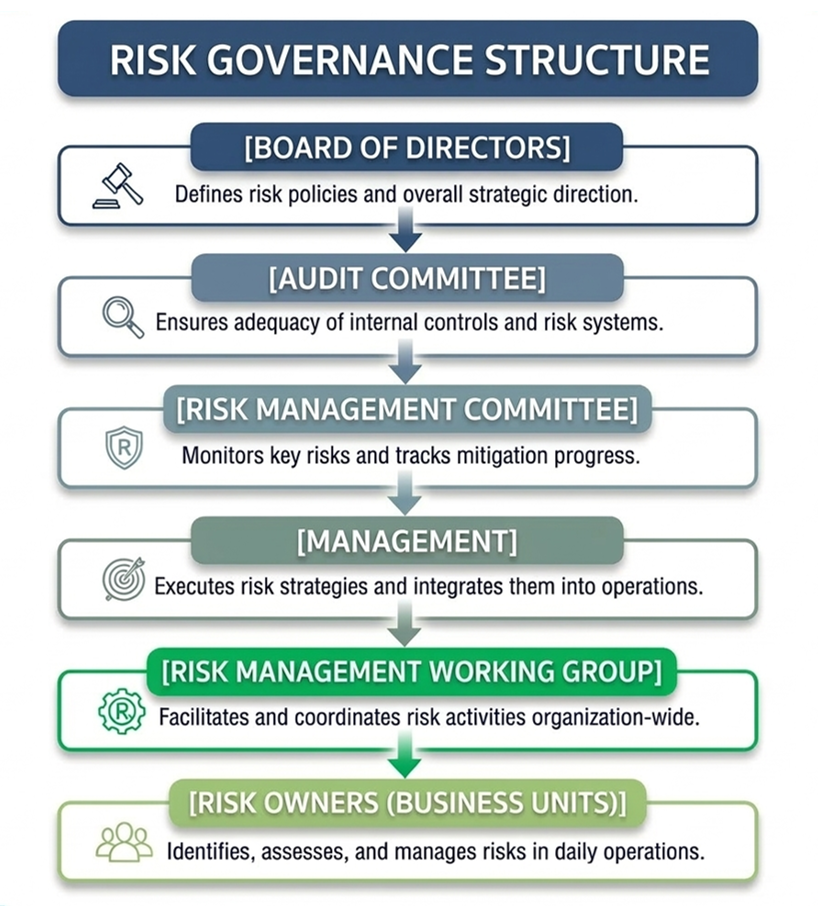
To ensure comprehensive and effective implementation across the organization, the Company has established the following governance structure and responsibilities:
Risk Culture
The Company is committed to fostering a risk management culture throughout the organization. The Board of Directors, executives, and all employees are required to recognize their roles and responsibilities as Risk Owners within their respective areas, ensuring that risk management is a standard part of routine operations. We promote the development of risk management knowledge for personnel at all levels, define risk assessment as a mandatory component of project management, and link risk management outcomes to departmental Key Performance Indicators (KPIs) to ensure effective alignment with business goals.
.
2.1.2 Risk Management Plan
The Company integrates risk management into the annual business planning, operations, and decision-making processes to systematically address threats to organizational objectives. Guided by the COSO ERM framework, the Company defines its Risk Appetite and Risk Tolerance to serve as a boundary for operations.
The risk identification and assessment process covers Strategic Risk, Financial Risk, Operational Risk, Compliance Risk, Information Technology Risk, Anti-Corruption Risk, and Environmental, Social, and Governance (ESG) Risks that may impact business sustainability.
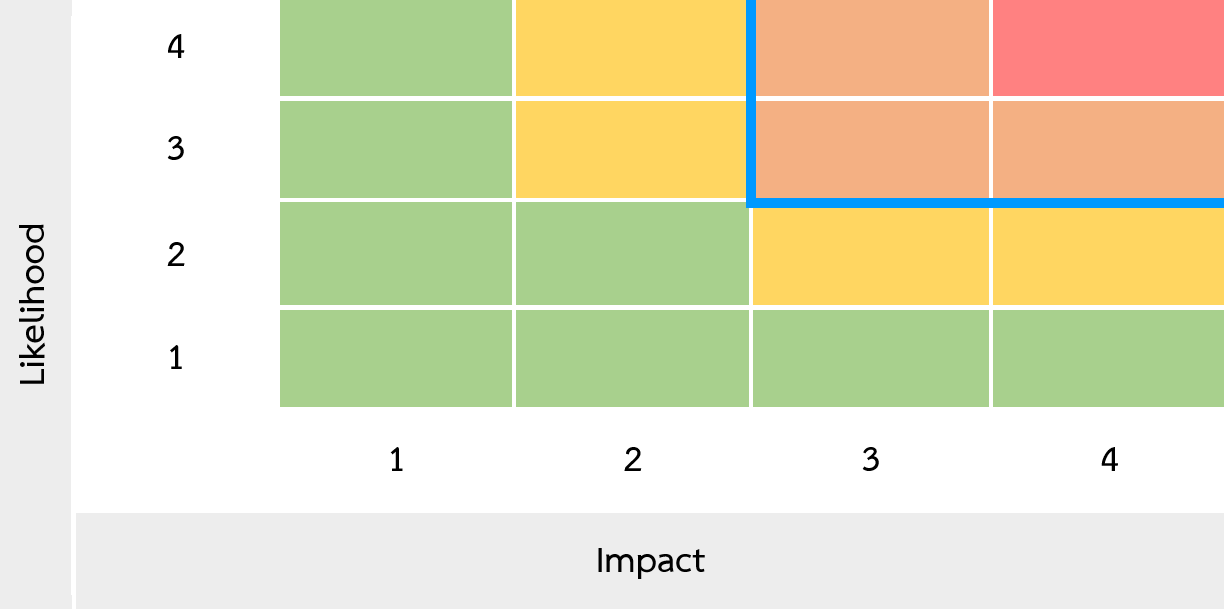
The Company has set its maximum Risk Tolerance at a "Medium" level. Any risk assessed at a "High" or "Very High" level requires the relevant departments to promptly define a Risk Response and monitor progress to mitigate the risk to an acceptable level within a specified timeframe.
The Company regularly monitors and reviews its risk management performance and reports to the Board of Directors.
In 2025, the Board evaluated the adequacy of the system based on the COSO framework and concluded that the Company’s risk management system is adequate and appropriate.
Policy Document Link
https://drive.google.com/file/d/1Mx9yFsG9KWx_vHv3D8z5sZeoCw2f734Y/view
Page Number in Report
1-7
Risk Factors — Overview
Risk Factors — Introduction
2025 Risk Management Overview and Strategy
The Company emphasizes a comprehensive context analysis of both internal and external business environments. This covers dimensions including economic, social, political, technological, environmental, and regulatory factors, as well as the competitive landscape within the digital solutions industry.
In 2025, the Risk Management Committee enhanced the risk assessment process by integrating Environmental, Social, and Governance (ESG) concepts into the core strategy. The assessment considers both Existing Risks and Emerging Risks to ensure preparedness for shifts that may impact future business growth. The Company manages risks across the following key areas:
Strategic Risk
Operational Risk
Human Resource Risk
Financial Risk
Fraud & Corruption Risk
Compliance Risk
IT Risk
ESG Risk
Emerging Risk
Summary of 2025 Risk Management Performance and Monitoring
Throughout 2025, the Company drove a proactive approach to risk management through continuous monitoring and evaluation mechanisms as follows:
Monitoring: The Company tracks risk statuses using Key Risk Indicators (KRIs). Results are reported to the Risk Management Working Group on a quarterly basis and subsequently presented to the Risk Management Committee and the Board of Directors, respectively. This ensures that risks are managed adequately and appropriately within the organization’s defined Risk Appetite.
Risk Communication & Culture: The Company focuses on fostering a robust Risk Culture by providing risk management training to executives and employees at all levels. Furthermore, Post-tests are conducted to evaluate the effectiveness of the training. This results in increased risk awareness among personnel, and supporting their ability to respond to unforeseen events in an appropriate and timely manner.
Risks to the Company's Business Operations
Risk Register
| Risk Name | Risk Characteristics | Consequences | Management Measures | Related Risk Factors |
|---|---|---|---|---|
| Risk from Reliance on Few Software Developers (Suppliers) | The Company utilizes MENDIX as its core platform for developing and delivering digital solutions to customers. As the primary software for business operations, MENDIX license purchases in 2025 accounted for 35.68% of the total purchase value. Consequently, the Company has a high level of reliance on this software developer, posing a risk should the Company fail to renew the agreement or have its distributor status terminated. f f | Such circumstances could significantly affect service delivery capability, business continuity, revenue generation, and customer confidence. The Company may also incur additional costs in transitioning to alternative technologies within a limited timeframe. | The Company recognizes the risk of relying on the MENDIX platform and has established management guidelines to mitigate impacts and ensure sustainability, as follows:
Through ongoing supplier relationship management, technology risk diversification, and continuous development of the Company’s proprietary solutions, which reduce reliance on external providers, the Company assesses that this risk is at a manageable level. | 735 · Description: Reliance on large partners / distributors or few partners / distributors · Info category: STRATEGIC_RISK |
| Risk from Investment in Joint Ventures | The Company has invested in a joint venture, Zero One Co., Ltd., to expand opportunities in specialized industrial software solutions. As this business operates in a rapidly evolving technological environment, its success depends on effective collaboration between partners and the ability to respond to technological change. | If the new business requires a longer payback period or customer expansion does not meet expectations during the early stages, the Company’s share of profit from investment may be temporarily affected. However, the potential impact on the Company’s overall financial position is considered limited. | In 2025, the Company continues to prioritize close governance and operational monitoring of the joint venture through three key management mechanisms:
Through prudent investment evaluation processes and established joint governance mechanisms with partners, the Company assesses that this risk is at a manageable level with close monitoring. | 1716 · Description: New business risk · Info category: STRATEGIC_RISK |
| Risk from Revenue Concentration in a Small Number of Major Customers | Due to the nature of the Company’s business, which focuses on providing Customized Enterprise Solutions for large organizations, individual projects often carry high contract values. Consequently, in 2025, the Company derived revenue from one major customer, which accounted for 10.8% of total revenue. While this client maintains a strong, long-term business relationship with the Company, reliance on a single major customer could lead to uncertainty should there be any changes in the client’s procurement policies. | A significant shift in procurement policy or a reduction in service volume by this major customer could impact short-term revenue. However, as the services involve the development of complex systems critical to the client's core operations, the risk of service termination is considered limited. | The Company has established measures to mitigate revenue concentration risks by focusing on diversifying revenue sources and developing recurring income models as follows:
Through regular monitoring and review of customer base expansion strategies, the Company assesses that the risk arising from reliance on a small number of major customers is at a manageable level with close monitoring. The Company continues to diversify its revenue base to enhance long-term cash flow stability. | 734 · Description: Reliance on large customers or few customers · Info category: STRATEGIC_RISK |
| Risk from Project Cost Management and Contractual Deliverables | As a digital solution provider operating on a project-based model, the Company places the utmost importance on managing project milestones according to established plans. However, the complexity of technical specifications and the initial gathering of user requirements—which may undergo adjustments to align with the client’s evolving business environment—can lead to more detailed system testing or acceptance procedures than originally planned. These factors may impact human resource allocation and increase man-hours during certain periods. | Deviations in operational timelines or delivery milestones may affect revenue recognition and project gross profit margins in certain accounting periods. This is due to potential incremental costs from resource management required to maintain service quality and meet agreed-upon standards. Furthermore, delays in delivery may, in some cases, trigger penalty clauses specified in contracts, which could impact the overall profitability of the project if the Company is unable to manage cost variances effectively. | The Company focuses on proactive project management to control costs and maintain gross profit margins through the following key measures:
Through structured project management practices and clear governance mechanisms, the Company assesses that this risk is at a manageable level, with ongoing monitoring to ensure alignment with project plans and contractual obligations. | 1725 · Description: Income volatility · Info category: FINANCIAL_RISK · 746 · Description: Delays in the development of future projects · Info category: OPERATIONAL_RISK |
| Risk from Human Rights Issues | The Company is committed to conducting business in accordance with the United Nations Guiding Principles on Business and Human Rights (UNGPs). However, as a technology service provider involving numerous personnel and business partners, the Company recognizes potential risks of human rights violations. These risks are categorized into two main dimensions based on the Human Rights Due Diligence (HRDD) process: 1. Internal Operations: Covers risks related to employees and internal personnel, such as discrimination in hiring or promotion, gender or opportunity inequality, occupational health and safety in the workplace, and ensuring welfare and compensation comply with labor laws and international standards. 2. Value Chain: Covers risks arising from suppliers and business partners within the supply chain. This includes discrimination or rights violations against laborers and employees, unsafe working conditions that do not meet legal or labor standards, child labor, forced labor, or human trafficking in production or service processes, as well as operations that may impact or violate the rights of communities and the environment surrounding the suppliers' operational areas. | Any human rights violation, in any dimension, could significantly damage the Company’s image and reputation. It may also lead to legal disputes, loss of business opportunities from failing to meet the sustainability requirements of leading corporate clients, and affect long-term investor confidence. |
Through strict adherence to these policies and measures, from the past to the present year 2025, the Company has found no cases of human rights violations and has received no complaints regarding human rights from internal personnel, value chain partners, or surrounding communities and stakeholders in any dimension. Remediation Mechanism: To ensure preparedness and demonstrate responsibility for potential impacts, the Company has established formal and timely mitigation mechanisms as follows: 1. Fact-Finding Process: Upon receiving a report or complaint, the Company will urgently appoint a working group to investigate the facts, maintaining neutrality and strictly protecting the confidentiality of the whistleblower’s information. 2. Ceasing and Mitigating Impacts: If a violation is confirmed, the Company will immediately cease the activities causing the violation and develop a plan to mitigate the impact on the affected parties as appropriate, such as formal written apologies, financial compensation, or restoration of lost rights. 3. Prevention of Recurrence: The Company will analyze the root cause of the violation to improve policies, work processes, or internal controls. This includes providing additional training to relevant parties to prevent similar incidents from recurring in the future. Through these transparent management measures and remediation mechanisms that appropriately protect the rights of all stakeholders, the Company assesses that human rights risk is at a manageable level. This reflects the Company’s commitment to corporate governance, respect for human dignity, and the creation of an organizational culture rooted in equality for sustainable growth. | 758 · Description: Violations of laws and regulations · Info category: COMPLIANCE_RISK · 733 · Description: Business operations of partners in the supply chain · Info category: STRATEGIC_RISK · 1717 · Description: ESG risk · Info category: STRATEGIC_RISK · 753 · Description: Impact on human rights · Info category: OPERATIONAL_RISK |
| Risk of Reliance on Key Personnel and Shortage of Specialized Talent | As a Digital Solution provider, the Company places the highest priority on human resource management, which serves as the fundamental pillar for creating value and innovation for customers across all operational processes. However, amidst the rapid transformation of the digital industry, the Company recognizes challenges in personnel management across two primary dimensions that may impact business continuity: 1. Key Person Dependency: Important project execution and strategic decision-making may still be tied to senior executives. This includes business opportunities linked to personal networks and specialized tacit knowledge accumulated within individuals that has not yet been fully institutionalized into the Company’s central systems. This poses a risk to organizational stability should there be changes in such key personnel. f f 2. IT Talent Shortage: The IT labor market is currently highly competitive. The Company may face risks from the loss of key talent or the inability to attract new personnel if the compensation structure, career paths, or performance appraisal systems do not appropriately meet employee expectations. Such factors could affect job satisfaction and the continuity of business operations. | The aforementioned risks could impact the Company’s competitiveness, business expansion, and lead to delays in delivering key projects. Without a clear Succession Plan or the ability to retain strategic institutional knowledge, the Company’s long-term reputation and the confidence of investors and business partners could be affected. |
Through the implementation of human resource strategies, including talent development, succession planning, and employee engagement initiatives, the Company assesses that the risk is at a manageable level with close monitoring, in order to support the continuity of critical business operations. | 738 · Description: Reliance on employees in key positions · Info category: OPERATIONAL_RISK · 739 · Description: Shortage or reliance on skilled workers · Info category: OPERATIONAL_RISK |
| Risk of Working Capital Management and Trade Receivables | Due to the nature of the Company’s business, which primarily operates on a project-based model, payment terms are generally structured based on project milestones (Milestone-based Payment). Consequently, it is essential for the Company to manage its working capital in alignment with project timelines. However, if system acceptance or project delivery is delayed beyond the schedule, or if customers are unable to make payments as planned, collections may not meet projected targets. Furthermore, any postponement of payment schedules for major projects could result in cash flow management discrepancies during certain periods. | These factors could directly impact financial liquidity and the flexibility of working capital management used for operations. It may also affect the achievement of the Company’s total revenue targets in each accounting period if the Company is unable to appropriately balance project costs incurred against incoming revenue. | The Company adheres to the principles of disciplined and transparent financial management to strengthen cash flow stability and maintain long-term financial security. The following measures and guidelines have been established:
Through effective liquidity management measures and systematic monitoring of receivables, the Company assesses that this risk is at a manageable level, to maintain financial stability and appropriate liquidity. | 763 · Description: Default on payment or exchange of goods · Info category: FINANCIAL_RISK · 1724 · Description: Liquidity risk · Info category: FINANCIAL_RISK · 1725 · Description: Income volatility · Info category: FINANCIAL_RISK |
| Risk from Corruption and Bribery | The Company prioritizes transparency across all business processes and recognizes that corruption is a potential risk that can manifest in various forms. This includes offering or receiving benefits to influence decision-making in procurement processes, project bidding, or transactions with external agencies, as well as the unauthorized use of corporate assets or internal information for personal gain. Such actions constitute a violation of the Company’s Good Corporate Governance policy and Code of Conduct. f f | The occurrence of corruption could significantly damage the Company’s reputation, credibility, and stakeholder confidence. Furthermore, it may lead to financial loss and legal liabilities, affecting operational efficiency, organizational culture, and the Company’s long-term business continuity and sustainable growth. | The Company regards corporate governance and ethical business practices as the fundamental pillars of its operations, maintaining a "Zero Tolerance" policy toward all forms of corruption. The following measures have been established:
Since its founding in 2008 through 2025, the Company has had no recorded instances of corruption or any related grievances. Through the implementation of robust corporate governance practices and stringent anti-corruption policies and measures, the Company assesses that this risk is at a low level, while continuing to uphold transparency and integrity in its business operations. | 758 · Description: Violations of laws and regulations · Info category: COMPLIANCE_RISK · 759 · Description: Corporate Governance · Info category: COMPLIANCE_RISK · 1717 · Description: ESG risk · Info category: STRATEGIC_RISK · 754 · Description: Corruption · Info category: OPERATIONAL_RISK |
| Risk of Climate Transition and Sustainability | The Company recognizes the global shift toward climate change adaptation. While the Company’s digital technology services face relatively low physical risks from natural disasters, it prioritizes preparedness for Transition Risks to meet stakeholder expectations and increasingly stringent government regulations and policies. These risks are categorized into two primary dimensions: 1. Regulatory and Policy Risks: Preparing for emerging legislation, such as the Climate Change Act, as well as greenhouse gas (GHG) emission reporting and control measures, which may impact operational costs. 2. Strategic and Supply Chain Risks: Expectations from partners and major corporate clients who have begun implementing Green Supply Chain requirements. Meeting these criteria is essential for maintaining the Company's competitive edge. | These factors may influence competitiveness, particularly the potential loss of opportunities in bidding for large-scale projects with rigorous sustainability requirements, which could affect total revenue targets. Failure to comply with laws or sustainability disclosure standards may lead to higher operating costs and diminish the confidence of investors and financial institutions regarding access to capital. Furthermore, intensified natural disasters could disrupt Business Continuity and service delivery in some cases, potentially affecting the Company's image and service standards. |
Governance Structure: The Company recognizes that managing climate-related risks requires strategic agility. Consequently, long-term risk and opportunity management is overseen by the Board of Directors. The Risk Management Committee is responsible for assessment and monitoring, while the Sustainability Strategic Management Working Group drives the implementation of policies and plans. The Chief Executive Officer (CEO) oversees strategic direction to strengthen business resilience in accordance with international regulations and standards. Through these measures, the Company assesses that climate change and sustainability-related risks are at a manageable level with close monitoring, with a focus on adaptation and the development of solutions that support long-term sustainable growth. | 756 · Description: Change in laws and regulations · Info category: COMPLIANCE_RISK · 1717 · Description: ESG risk · Info category: STRATEGIC_RISK · 1719 · Description: Climate change and disasters · Info category: STRATEGIC_RISK |
| Risk of Cybersecurity Threats and Personal Data Breaches | Since the Company’s business operations rely on information technology as the core for service delivery and communication, the Company prioritizes maintaining system stability and security to protect data—including both business secrets and personal information. However, storing and processing data through information systems introduces fundamental technological risks as follows: 1. Data Security and Cybersecurity Threats: Risks from unauthorized system access or various forms of malware attacks. These could lead to the leakage or loss of personal data belonging to customers, employees, and stakeholders if security updates or access control measures are insufficient. 2. Compliance with Personal Data Protection Standards (PDPA): Risks arising from personal data management that may not fully align with the Personal Data Protection Act (PDPA), such as errors in the collection, use, or disclosure of stakeholder data due to operational or supporting system failures. 3. System Stability and Continuity: Risks from accidents or technical failures that could affect data availability and service delivery. This includes risks associated with external service providers who may, in certain cases, fail to maintain agreed-upon security standards. | A security breach or personal data leak could significantly impact stakeholder confidence and the Company’s reputation, leading to legal liabilities and fines under the PDPA. Operationally, system failures may result in costs for data recovery and short-term brand remediation. However, the Company has established a rigorous governance structure and audit measures to limit the likelihood of such occurrences and minimize potential damage. | The Company prioritizes building a secure information technology foundation through comprehensive management measures as follows:
Through systematic surveillance and comprehensive preventive measures, the Company assesses that this risk is at a manageable level. In 2025, no incidents of cyberattacks or personal data breaches were identified. | 758 · Description: Violations of laws and regulations · Info category: COMPLIANCE_RISK · 744 · Description: Information security and cyber-attack · Info category: OPERATIONAL_RISK · 1720 · Description: System disruption risk · Info category: OPERATIONAL_RISK |
| Emerging Risk: Risk from Rapid Digital Technology Transformation | The Company faces risks arising from the rapid evolution of digital technology, particularly the development and application of Artificial Intelligence (AI), which increasingly influences business models and consumer behavior. This risk stems from the necessity for the Company to continuously adapt, innovate, and enhance its capabilities to respond to market demands and maintain its competitive edge. | Failure to adapt or develop technologies in a timely manner according to these changes could adversely affect the Company’s competitiveness, business opportunities, and long-term operational performance. | The Company focuses on proactive adaptation to transform technological challenges into business opportunities through the following systematic management approaches:
Through continuous monitoring of technology trends and ongoing adjustments to business strategies, the Company assesses that the risk is at a manageable level with close monitoring, while also being able to transform challenges arising from such changes into opportunities to enhance competitive advantage and achieve sustainable long-term growth. f f f | 729 · Description: Behavior or needs of customers / consumers · Info category: STRATEGIC_RISK · 732 · Description: Changes in technologies · Info category: STRATEGIC_RISK · 743 · Description: Product obsolescence · Info category: OPERATIONAL_RISK |
Risks to Securities Holders' Investment
Risk Register
| Risk Name | Risk Characteristics | Consequences | Management Measures | Related Risk Factors |
|---|---|---|---|---|
| Risk from Volatility of Economic Conditions May Affect the Company's Performance | The Company faces risks associated with fluctuations in its operational performance and capital market conditions, which are driven by various factors. These include the Company's financial results, related industry and economic circumstances, changes in government policies, and alterations in relevant regulations and criteria, as well as the overall stock market trading situation. Furthermore, as the Company primarily provides customized digital solutions through a project-based model, its revenue may fluctuate according to economic shifts and client decision-making, while the Company's major costs consist of employee expenses, which are regular expenditures. | The volatility of such revenue and costs may directly impact the Company’s operational performance, cash flow, profitability, and dividend payments. This could also affect investor confidence and the Company’s common stock price. Consequently, investors bear the risk of potential investment losses and may not receive dividends or returns at the anticipated level. | The Company assesses that the risks associated with economic volatility remain at a manageable level, supported by its Recurring Income structure. This includes revenue from maintenance services, MENDIX software licensing, and cloud services, which accounted for 55%, 62%, and 56% of the Company’s total revenue in 2023, 2024, and 2025, respectively. Furthermore, the Company prioritizes disciplined credit and cash flow management by establishing criteria and procedures for assessing customer credibility prior to project acceptance. Appropriate payment conditions are determined, and debtor status is reported at monthly Executive Committee meetings to monitor abnormal delays and establish follow-up guidelines, thereby reducing collection risks and maintaining debt quality. The Company’s financial strength is also reflected through its liquidity indicators. During the period from 2023 to 2025, the Company maintained liquidity ratios of 4.32, 4.58, and 4.03, respectively, with cash flows from operating activities of 48.14 million baht, 24.60 million baht, and 84.98 million baht, respectively. These figures demonstrate the Company's capacity to support operational expenditures under a stable recurring income structure and a healthy liquidity position. However, the Company consistently monitors economic situations and business environmental factors to evaluate potential impacts and appropriately adjust its risk management approach to suit the prevailing circumstances. There may be other unknown risk factors or risks considered insignificant by the Company at present. Therefore, investors should consider additional risk factors when investing in the Company's securities. | 768 · Description: Return from investment of securities holder · Info category: HOLDER_RISK |